


Page 149 - Fisika Terapan for Engineers and Scientists
P. 149
11.3  Inelastic Collisions in One Dimension                   349


                        (a)
                            Boxcar 1 is                           Boxcar 2 is
                            moving “projectile.”                  stationary “target.”
                                              v 1

                                1                             2
                                                                                     x


                        (b)


                                                            v CM
                                              1                  2
                                                                                     x

                                                 In a totally inelastic
                                                 collision, target and
                                                 projectile lock together.

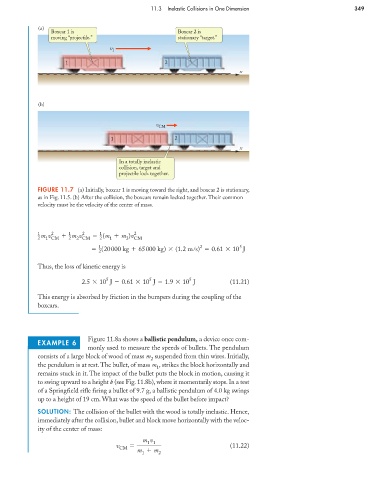
                        FIGURE 11.7 (a) Initially, boxcar 1 is moving toward the right, and boxcar 2 is stationary,
                        as in Fig. 11.5. (b) After the collision, the boxcars remain locked together. Their common
                        velocity must be the velocity of the center of mass.


                        1   2    1   2     1         2
                        2 m v  	 m v      (m 	 m )v  CM
                                              1
                                    2 CM
                                 2
                          1 CM
                                                   2
                                           2
                                                                         2
                                                                                     5
                                          1
                                          (20 000 kg 	 65 000 kg)   (1.2 m s)   0.61   10 J
                                          2
                        Thus, the loss of kinetic energy is
                                             5            5           5
                                     2.5   10  J   0.61   10  J   1.9   10  J     (11.21)
                        This energy is absorbed by friction in the bumpers during the coupling of the
                        boxcars.

                                       Figure 11.8a shows a ballistic pendulum, a device once com-
                        EXAMPLE 6
                                       monly used to measure the speeds of bullets. The pendulum
                        consists of a large block of wood of mass m suspended from thin wires. Initially,
                                                          2
                        the pendulum is at rest.The bullet, of mass m , strikes the block horizontally and
                                                            1
                        remains stuck in it. The impact of the bullet puts the block in motion, causing it
                        to swing upward to a height h (see Fig. 11.8b), where it momentarily stops. In a test
                        of a Springfield rifle firing a bullet of 9.7 g, a ballistic pendulum of 4.0 kg swings
                        up to a height of 19 cm. What was the speed of the bullet before impact?

                        SOLUTION: The collision of the bullet with the wood is totally inelastic. Hence,
                        immediately after the collision, bullet and block move horizontally with the veloc-
                        ity of the center of mass:
                                                        m v
                                                         1 1
                                                v                                 (11.22)
                                                 CM
                                                      m 	 m
                                                       1    2

