


Page 151 - Fisika Terapan for Engineers and Scientists
P. 151
11.4  Collisions in Two and Three Dimensions                    351


                     11.4 COLLISIONS IN TWO

                     AND THREE DIMENSIONS


                     In the previous sections, we have focused on collisions on a straight line, in one dimen-
                     sion. Collisions in two or three dimensions are more difficult to analyze, because the
                     conservation laws for momentum and energy do not provide sufficient information to
                     determine the final velocities completely in terms of the initial velocities. Momentum
                     is always conserved during a collision, and this conservation provides one equation for
                     each of the x, y, and z directions. If it is known that the collision is totally elastic, then
                     conservation of the total kinetic energy provides another equation. However, these are
                     not enough to determine the three final velocity components for each and every particle.
                     Some information concerning the final velocities must also be known or measured.
                        The case of totally inelastic collisions is an exception: in this case, the conserva-
                     tion of momentum determines the outcome completely, even in two or three dimen-
                     sions.The particles stick together, and their final velocities coincide with the velocity
                     of the center of mass, as illustrated by the following example. The subsequent exam-
                     ple explores a case where the solution exploits some knowledge of the final velocities.


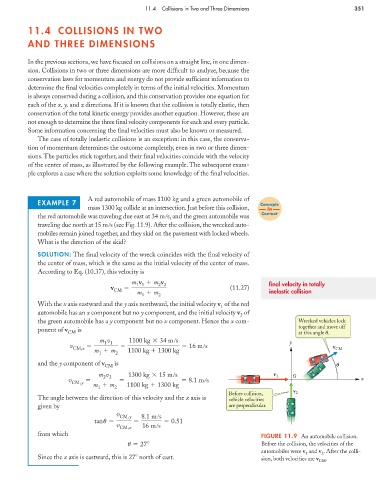
                                       A red automobile of mass 1100 kg and a green automobile of
                        EXAMPLE 7                                                          Concepts
                                       mass 1300 kg collide at an intersection. Just before this collision,  in
                                                                                            Context
                        the red automobile was traveling due east at 34 m s, and the green automobile was
                        traveling due north at 15 m s (see Fig. 11.9). After the collision, the wrecked auto-
                        mobiles remain joined together, and they skid on the pavement with locked wheels.
                        What is the direction of the skid?
                        SOLUTION: The final velocity of the wreck coincides with the final velocity of
                        the center of mass, which is the same as the initial velocity of the center of mass.
                        According to Eq. (10.37), this velocity is
                                                    m v 	 m v                                 final velocity in totally
                                                            2 2
                                                      1 1
                                              v                                   (11.27)
                                               CM                                             inelastic collision
                                                      m 	 m
                                                       1    2
                        With the x axis eastward and the y axis northward, the initial velocity v of the red
                                                                               1
                        automobile has an x component but no y component, and the initial velocity v of
                                                                                     2
                        the green automobile has a y component but no x component. Hence the x com-    Wrecked vehicles lock
                                                                                                       together and move off
                        ponent of v  is
                                 CM                                                                    at this angle q.
                                           m v      1100 kg   34 m s                                y
                                            1 1
                                 v                                   16 m s                                      v
                                   CM,x                                                                           CM
                                         m 	 m     1100 kg 	 1300 kg
                                          1    2
                        and the y component of v  is
                                            CM                                                                    q
                                          m v      1300 kg   15 m s                            v 1   O
                                            2 2
                                 v                                   8.1 m s                                              x
                                  CM, y
                                         m 	 m     1100 kg 	 1300 kg
                                          1    2
                                                                                  Before collision,  v 2
                        The angle between the direction of this velocity and the x axis is   vehicle velocities
                        given by                                                  are perpendicular.
                                                v CM, y  8.1 m s
                                         tanu                   0.51
                                                v       16 m s
                                                 CM, x
                        from which
                                                                                            FIGURE 11.9 An automobile collision.
                                                   u   27                                   Before the collision, the velocities of the
                                                                                            automobiles were v and v . After the colli-
                                                                                                              2
                                                                                                         1
                        Since the x axis is eastward, this is 27  north of east.            sion, both velocities are v  .
                                                                                                             CM

