


Page 152 - Fisika Terapan for Engineers and Scientists
P. 152
352                                CHAPTER 11  Collisions


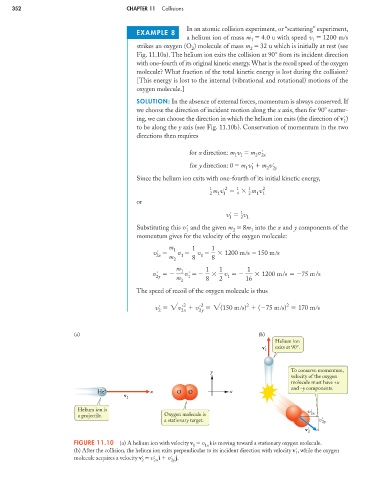
                                                                     In an atomic collision experiment, or “scattering” experiment,
                                                      EXAMPLE 8
                                                                     a helium ion of mass m   4.0 u with speed v   1200 m s
                                                                                         1                 1
                                                      strikes an oxygen (O ) molecule of mass m   32 u which is initially at rest (see
                                                                       2                2
                                                      Fig. 11.10a). The helium ion exits the collision at 90  from its incident direction
                                                      with one-fourth of its original kinetic energy.What is the recoil speed of the oxygen
                                                      molecule? What fraction of the total kinetic energy is lost during the collision?
                                                      [This energy is lost to the internal (vibrational and rotational) motions of the
                                                      oxygen molecule.]
                                                      SOLUTION: In the absence of external forces, momentum is always conserved. If
                                                      we choose the direction of incident motion along the x axis, then for 90  scatter-
                                                      ing, we can choose the direction in which the helium ion exits (the direction of v' )
                                                                                                                     1
                                                      to be along the y axis (see Fig. 11.10b). Conservation of momentum in the two
                                                      directions then requires

                                                                      for x direction: m v   m v'
                                                                                    1 1   2 2x
                                                                      for y direction: 0   m v' 	 m v'
                                                                                       1 1   2 2y
                                                      Since the helium ion exits with one-fourth of its initial kinetic energy,
                                                                            1    2  1   1   2
                                                                            2  m v'     m v
                                                                                    4
                                                                                        2
                                                                                          1 1
                                                                              1 1
                                                      or
                                                                                     1
                                                                                 v'   v
                                                                                  1  2 1
                                                      Substituting this v' and the given m   8m into the x and y components of the
                                                                     1             2     1
                                                      momentum gives for the velocity of the oxygen molecule:
                                                                m 1    1     1
                                                           v'     v    v        1200 m s   150 m s
                                                            2x  m  1     1
                                                                 2     8     8
                                                                  m 1      1   1       1
                                                           v'       v'          v           1200 m/s   75 m/s
                                                            2y    m  1           1
                                                                   2       8   2       16
                                                      The speed of recoil of the oxygen molecule is thus
                                                                    2    2             2           2
                                                           v'   2v' 	 v'   2(150 m s) 	 ( 75 m s)   170 m s
                                                            2      2x    2y

                                   (a)                                                     (b)
                                                                                                Helium ion
                                                                                            v' 1  exits at 90°.


                                                                            y                        To conserve momentum,
                                                                                                     velocity of the oxygen
                                                                                                     molecule must have +x
                                                                                                     and –y components.
                                          He +            x       O   O           x
                                                  v 1
                                    Helium ion is                                                         v'
                                    a projectile.             Oxygen molecule is                           2 x
                                                              a stationary target.                           v' 2 y
                                                                                                         v' 2

                                   FIGURE 11.10  (a) A helium ion with velocity v   v i is moving toward a stationary oxygen molecule.
                                                                          1x
                                                                       1
                                   (b) After the collision, the helium ion exits perpendicular to its incident direction with velocity v' , while the oxygen
                                                                                                      1
                                   molecule acquires a velocity v'   v' i 	 v' j.
                                                       2   2x   2y

