


Page 150 - Fisika Terapan for Engineers and Scientists
P. 150
350                                CHAPTER 11  Collisions


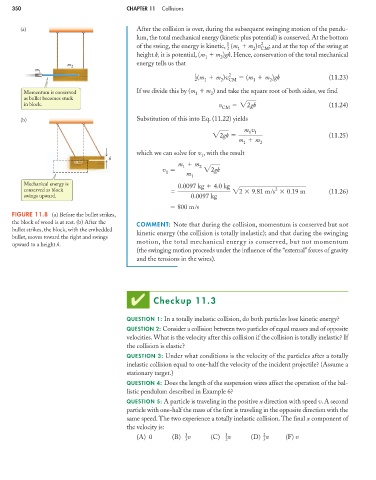
                   (a)                                After the collision is over, during the subsequent swinging motion of the pendu-
                                                      lum, the total mechanical energy (kinetic plus potential) is conserved. At the bottom
                                                                                 1          2
                                                      of the swing, the energy is kinetic, (m 	 m )v  ; and at the top of the swing at
                                                                                 2  1    2  CM
                                                      height h, it is potential, (m 	 m )gh. Hence, conservation of the total mechanical
                                                                           1   2
                                 m 2                  energy tells us that
                       m 1
                                                                       1          2
                                                                       2 (m 	 m )v CM    (m 	 m )gh             (11.23)
                                                                          1
                                                                               2
                                                                                              2
                                                                                         1
                    Momentum is conserved             If we divide this by (m 	 m ) and take the square root of both sides, we find
                                                                            2
                                                                        1
                    as bullet becomes stuck
                    in block.                                                  v     22gh                       (11.24)
                                                                                CM
                   (b)                                Substitution of this into Eq. (11.22) yields
                                                                                      m v
                                                                                        1 1
                                                                             22gh                               (11.25)
                                                                                     m 	 m
                                                                                      1    2
                                                      which we can solve for v , with the result
                                                                         1
                                             h
                                                                  m 	 m  2
                                                                    1
                                                              v              22gh
                                                               1     m
                                                                      1
                    Mechanical energy is                          0.0097 kg 	 4.0 kg
                                                                                                2
                    conserved as block                                             22   9.81 m s   0.19 m       (11.26)
                    swings upward.                                    0.0097 kg
                                                                  800 m s
                FIGURE 11.8 (a) Before the bullet strikes,
                the block of wood is at rest. (b) After the
                                                      COMMENT: Note that during the collision, momentum is conserved but not
                bullet strikes, the block, with the embedded
                                                      kinetic energy (the collision is totally inelastic); and that during the swinging
                bullet, moves toward the right and swings
                                                      motion, the total mechanical energy is conserved, but not momentum
                upward to a height h.
                                                      (the swinging motion proceeds under the influence of the “external” forces of gravity
                                                      and the tensions in the wires).
                                                    ✔      Checkup 11.3


                                                   QUESTION 1: In a totally inelastic collision, do both particles lose kinetic energy?
                                                   QUESTION 2: Consider a collision between two particles of equal masses and of opposite
                                                   velocities. What is the velocity after this collision if the collision is totally inelastic? If
                                                   the collision is elastic?
                                                   QUESTION 3: Under what conditions is the velocity of the particles after a totally
                                                   inelastic collision equal to one-half the velocity of the incident projectile? (Assume a
                                                   stationary target.)
                                                   QUESTION 4: Does the length of the suspension wires affect the operation of the bal-
                                                   listic pendulum described in Example 6?
                                                   QUESTION 5: A particle is traveling in the positive x direction with speed v. A second
                                                   particle with one-half the mass of the first is traveling in the opposite direction with the
                                                   same speed.The two experience a totally inelastic collision.The final x component of
                                                   the velocity is:
                                                                     1
                                                                                            2
                                                                                 1
                                                      (A) 0      (B)  v     (C)  v      (D)  v     (F) v
                                                                                            3
                                                                                 2
                                                                     3

