


Page 155 - Fisika Terapan for Engineers and Scientists
P. 155
Problems                              355


                     QUESTIONS FOR DISCUSSION


                       1. According to the data given in Example 1, what percentage of  why is it more tiring to use the small ax? (Hint: Think about
                         the initial kinetic energy does the automobile have after the  the kinetic energy of your arms.)
                         collision?                                        11. If you throw an (elastic) baseball at an approaching train, the
                       2. A (foolish) stuntman wants to jump out of an airplane at high  ball will bounce back at you with an increased speed. Explain.
                         altitude without a parachute. He plans to jump while tightly  12. You are investigating the collision of two automobiles at an
                         encased in a strong safe which can withstand the impact on  intersection. The automobiles remained joined together after
                         the ground. How would you convince the stuntman to aban-  this collision, and their wheels made measurable skid marks
                         don this project?                                    on the pavement before they came to rest. Assume that during
                       3. In the crash test shown in the photographs of Fig. 11.1,  skidding all the wheels remained locked so that the decelera-
                         anthropomorphic dummies were riding in the automobile.  tion was entirely due to sliding friction. You know the direc-
                         These dummies were (partially) restrained by seat belts, which  tion of motion of the automobiles before the collision (drivers
                         limited their motion relative to the automobile. How would  are likely to be honest about this), but you do not know the
                         the motion of the dummies have differed from that shown in  speeds (drivers are likely to be dishonest about this). What do
                         these photographs if they had not been restrained by seat belts?  you have to measure at the scene of the accident to calculate
                       4. For the sake of safety, would it be desirable to design automo-  the speeds of both the automobiles before the collision?
                         biles so that their collisions are elastic or inelastic?  13. You are sitting in your car, stopped at an intersection. You
                       5. Two automobiles have collided at a north–south east–west inter-  notice another car approaching from behind, and you notice
                         section.The skid marks their tires made after the collision point  this car is not slowing down and is going to ram you. Because
                         roughly northwest. One driver claims he was traveling west; the  the time to impact is short, you have only two choices: push
                         other driver claims he was traveling south. Who is lying?  hard on your brake, or take your foot off the brake and give
                                                                              your car freedom to roll. Which of these tactics will minimize
                       6. Statistics show that, on the average, the occupants of a heavy
                                                                              damage to yourself? Which will minimize damage to your
                         (“full-size”) automobile are more likely to survive a crash than
                                                                              car? Which will minimize damage to the other car?
                         those of a light (“compact”) automobile. Why would you
                         expect this to be true?
                       7. In Joseph Conrad’s tale “Gaspar Ruiz”, the hero ties a cannon to
                         his back and, hugging the ground on all fours, fires several shots
                         at the gate of a fort. How does the momentum absorbed by Ruiz
                         compare with that absorbed by the gate? How does the energy
                         absorbed by Ruiz compare with that absorbed by the gate?
                       8. Give an example of a collision between two bodies in which
                         all of the kinetic energy is lost to inelastic processes.
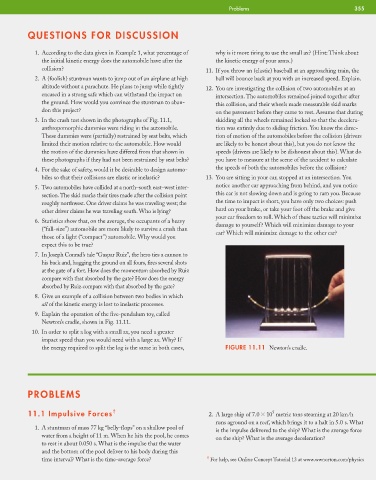
                       9. Explain the operation of the five-pendulum toy, called
                         Newton’s cradle, shown in Fig. 11.11.
                      10. In order to split a log with a small ax, you need a greater
                         impact speed than you would need with a large ax. Why? If
                         the energy required to split the log is the same in both cases,  FIGURE 11.11 Newton’s cradle.


                     PROBLEMS


                     11.1 Impulsive Forces     †                            2. A large ship of 7.0   10 metric tons steaming at 20 km h
                                                                                               5
                                                                              runs aground on a reef, which brings it to a halt in 5.0 s. What
                       1. A stuntman of mass 77 kg “belly-flops” on a shallow pool of
                                                                              is the impulse delivered to the ship? What is the average force
                         water from a height of 11 m. When he hits the pool, he comes
                                                                              on the ship? What is the average deceleration?
                         to rest in about 0.050 s. What is the impulse that the water
                         and the bottom of the pool deliver to his body during this
                         time interval? What is the time-average force?    †  For help, see Online Concept Tutorial 13 at www.wwnorton.com/physics

