


Page 176 - Fisika Terapan for Engineers and Scientists
P. 176
376                                CHAPTER 12  Rotation of a Rigid Body


                                                   QUESTION 2: The wheel of a bicycle rolls on a flat road. Is the angular velocity con-
                                                   stant if the translational velocity of the bicycle is constant? Is the angular acceleration
                                                   constant if the translational acceleration of the bicycle is constant?
                                                   QUESTION 3: A grinding wheel accelerates uniformly for 3 seconds after being turned
                                                   on. In the first second of motion, the wheel rotates 5 times. In the first two seconds of
                                                   motion, the total number of revolutions is:
                                                      (A) 6       (B) 10       (C) 15       (D) 20       (E) 25


                                                   12.4 MOTION WITH TIME-DEPENDENT
                                                   ANGULAR ACCELERATION


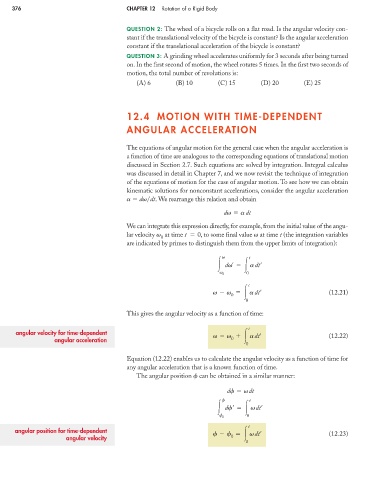
                                                   The equations of angular motion for the general case when the angular acceleration is
                                                   a function of time are analogous to the corresponding equations of translational motion
                                                   discussed in Section 2.7. Such equations are solved by integration. Integral calculus
                                                   was discussed in detail in Chapter 7, and we now revisit the technique of integration
                                                   of the equations of motion for the case of angular motion. To see how we can obtain
                                                   kinematic solutions for nonconstant accelerations, consider the angular acceleration
                                                       d  dt. We rearrange this relation and obtain
                                                                                d      dt

                                                   We can integrate this expression directly, for example, from the initial value of the angu-
                                                   lar velocity   at time t   0, to some final value   at time t (the integration variables
                                                             0
                                                   are indicated by primes to distinguish them from the upper limits of integration):

                                                                                         t
                                                                                 d
     dt
                                                                                       0
                                                                                 0
                                                                                  0     t
                                                                                          dt
                   (12.21)
                                                                                       0
                                                   This gives the angular velocity as a function of time:

                                                                                   0
                 angular velocity for time-dependent                               	    t  dt
                  (12.22)
                             angular acceleration
                                                                                       0

                                                   Equation (12.22) enables us to calculate the angular velocity as a function of time for
                                                   any angular acceleration that is a known function of time.
                                                      The angular position   can be obtained in a similar manner:

                                                                                   df    dt
                                                                                f         t
                                                                                 df
     dt
                                                                                       0
                                                                               f 0
                                                                                  0
                 angular position for time-dependent                           f   f    t  dt
                  (12.23)
                                angular velocity
                                                                                       0

