


Page 177 - Fisika Terapan for Engineers and Scientists
P. 177
12.4  Motion with Time-Dependent Angular Acceleration                  377


                        In the special case of constant angular acceleration  , Eq. (12.22) gives us
                           	  t, which agrees with our previous result, Eq. (12.17). If we insert this into
                          0                      t
                                                                    1
                                                                       2
                     Eq. (12.23), we obtain  f   f     ∫ 0 (  	  t)dt     t 	  t  ,  which agrees with
                                                                    2
                                             0      0           0
                     our previous Eq. (12.18).
                        In the general case of a time-dependent angular acceleration  , we proceed in the
                     same way: first, use Eq. (12.22) to find   as a function of time, and then insert this
                     function into Eq. (12.23) to find the angular position as a function of time, as in the
                     following example.


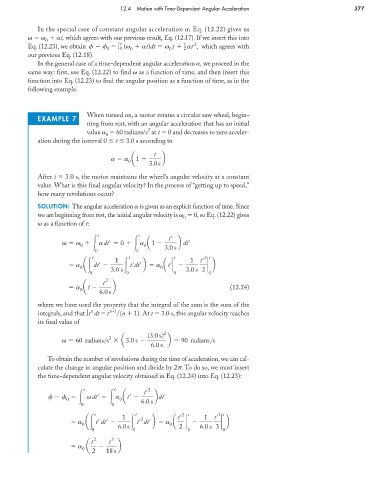
                                       When turned on, a motor rotates a circular saw wheel, begin-
                        EXAMPLE 7
                                       ning from rest, with an angular acceleration that has an initial
                                                         2
                                       value     60 radians/s at t   0 and decreases to zero acceler-
                                            0
                        ation during the interval 0   t   3.0 s according to
                                                           t
                                                    a 1      b
                                                   0
                                                          3.0s
                        After t   3.0 s, the motor maintains the wheel’s angular velocity at a constant
                        value. What is this final angular velocity? In the process of “getting up to speed,”
                        how many revolutions occur?
                        SOLUTION: The angular acceleration   is given as an explicit function of time. Since
                        we are beginning from rest, the initial angular velocity is     0, so Eq. (12.22) gives
                                                                    0
                          as a function of t:
                                     0    t            t       t
     œ
                                         	   dt
  0 	    a 1      b  dt
                                                        0

                                         0            0       3.0 s
                                     0    t    1    t            t    1  t
 2 t
                                      ¢  dt
        t
dt
b     a t
`       ` b
                                                             0
                                        0     3.0 s  0           0   3.0 s 2  0
                                            2
                                            t
                                      a t     b                                   (12.24)
                                     0
                                           6.0s
                        where we have used the property that the integral of the sum is the sum of the
                                        n     n+1
                        integrals, and that ∫t dt   t   (n 	 1). At t   3.0 s, this angular velocity reaches
                        its final value of
                                                         (3.0 s) 2
                                             2
                                   60 radians>s   a 3.0 s      b   90 radians>s
                                                          6.0 s
                           To obtain the number of revolutions during the time of acceleration, we can cal-
                        culate the change in angular position and divide by 2 . To do so, we must insert
                        the time-dependent angular velocity obtained in Eq. (12.24) into Eq. (12.23):

                                0     t         t       t
 2
                               f   f       dt
     a t
    b dt
                                                 0
                                     0        0        6.0 s
                                     0    t      1    t  2        t
 2 t  1  t
 3 t
                                      ¢  t
 dt
       t
 dt
 b     a   `        ` b
                                                                0
                                        0       6.0s  0            2  0  6.0 s 3  0
                                         2    3
                                        t    t
                                        a       b
                                     0
                                        2    18 s

