


Page 209 - Fisika Terapan for Engineers and Scientists
P. 209
13.3  Angular Momentum and Its Conservation                      409


                        (a)                                 (b)

                                            Ball of clay.


                                     v                                  v'

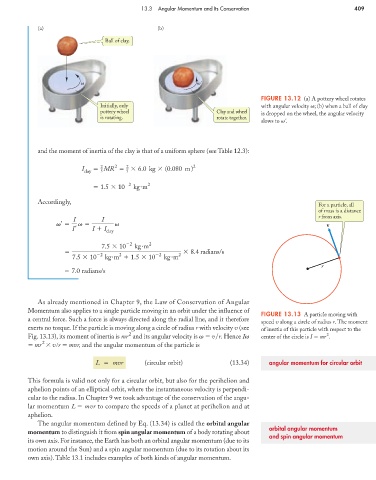
                                                                                            FIGURE 13.12 (a) A pottery wheel rotates
                                           Initially, only                                  with angular velocity  ; (b) when a ball of clay
                                           pottery wheel                      Clay and wheel  is dropped on the wheel, the angular velocity
                                           is rotating.                       rotate together.
                                                                                            slows to  '.


                        and the moment of inertia of the clay is that of a uniform sphere (see Table 12.3):

                                               2
                                                   2
                                           2
                                       I    MR     6.0 kg   (0.080 m)  2
                                      clay  5      5
                                                   2     2
                                           1.5   10  kg m
                        Accordingly,
                                                                                                             For a particle, all
                                                                                                             of mass is a distance
                                                                                                             r from axis.
                                   I       I
                                                                                                                v
                               œ
                                  I  œ  I   I
                                             clay
                                                    2     2
                                           7.5   10  kg m
                                                                      8.4 radians/s
                                                 2
                                  7.5   10  2   kg m   1.5   10  2   kg m 2
                                                                                                              r
                                  7.0 radians/s

                        As already mentioned in Chapter 9, the Law of Conservation of Angular
                     Momentum also applies to a single particle moving in an orbit under the influence of
                                                                                            FIGURE 13.13 A particle moving with
                     a central force. Such a force is always directed along the radial line, and it therefore
                                                                                            speed v along a circle of radius r. The moment
                     exerts no torque. If the particle is moving along a circle of radius r with velocity v (see  of inertia of this particle with respect to the
                                                   2
                                                                                                               2
                     Fig. 13.13), its moment of inertia is mr and its angular velocity is     v r. Hence I   center of the circle is I   mr .
                         2
                       mr   v	r   mvr, and the angular momentum of the particle is
                                         L     mvr      (circular orbit)          (13.34)     angular momentum for circular orbit

                     This formula is valid not only for a circular orbit, but also for the perihelion and
                     aphelion points of an elliptical orbit, where the instantaneous velocity is perpendi-
                     cular to the radius. In Chapter 9 we took advantage of the conservation of the angu-
                     lar momentum L   mvr to compare the speeds of a planet at perihelion and at
                     aphelion.
                        The angular momentum defined by Eq. (13.34) is called the orbital angular
                                                                                              orbital angular momentum
                     momentum to distinguish it from spin angular momentum of a body rotating about
                                                                                              and spin angular momentum
                     its own axis. For instance, the Earth has both an orbital angular momentum (due to its
                     motion around the Sun) and a spin angular momentum (due to its rotation about its
                     own axis). Table 13.1 includes examples of both kinds of angular momentum.

