


Page 210 - Fisika Terapan for Engineers and Scientists
P. 210
410                                CHAPTER 13  Dynamics of a Rigid Body


                                                                 CONSERVATION OF ANGULAR
                  PROBLEM-SOLVING TECHNIQUES
                                                                 MOMENTUM


                  The use of conservation of angular momentum in a problem  2 Then write an expression for the angular momentum at
                  involving rotational motion involves the familiar three steps  another instant [Eq. (13.31)].
                  we used with conservation of momentum or of energy in
                                                                    3 And then rely on conservation of angular momentum to
                  translational motion:
                                                                       equate the two expressions [Eq. (13.32)].This yields one
                  1 First write an expression for the angular momentum at  equation, which can be solved for an unknown quantity,
                     one instant of the motion [Eq. (13.30)].          such as the final angular speed.


                                                    ✔      Checkup 13.3


                                                   QUESTION 1: A hoop and a uniform disk have equal radii and equal masses. Both are
                                                   spinning with equal angular speeds. Which has the larger angular momentum? By
                                                   what factor?
                                                   QUESTION 2: Two automobiles of equal masses are traveling around a traffic circle
                                                   side by side, with equal angular velocities. Which has the larger angular momentum?
                                                         QUESTION 3: You sit on a spinning stool with your legs tucked under the seat.
                                                         You then stretch your legs outward. How does your angular velocity change?
                                                         QUESTION 4: Consider the spinning skater described in Fig. 13.10. While
                                                         she brings her arms close to her body, does the rotational kinetic energy remain
                                                         constant?
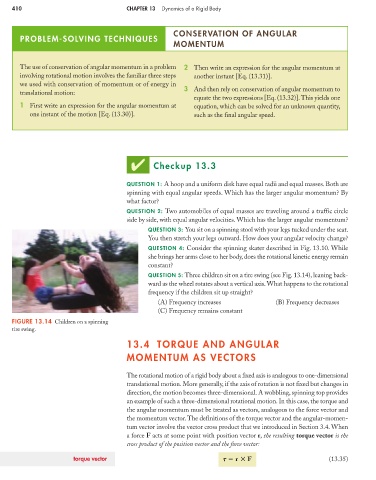
                                                         QUESTION 5: Three children sit on a tire swing (see Fig. 13.14), leaning back-
                                                         ward as the wheel rotates about a vertical axis. What happens to the rotational
                                                         frequency if the children sit up straight?
                                                            (A) Frequency increases             (B) Frequency decreases
                                                            (C) Frequency remains constant
                FIGURE 13.14 Children on a spinning
                tire swing.

                                                   13.4 TORQUE AND ANGULAR
                                                   MOMENTUM AS VECTORS


                                                   The rotational motion of a rigid body about a fixed axis is analogous to one-dimensional
                                                   translational motion. More generally, if the axis of rotation is not fixed but changes in
                                                   direction, the motion becomes three-dimensional. A wobbling, spinning top provides
                                                   an example of such a three-dimensional rotational motion. In this case, the torque and
                                                   the angular momentum must be treated as vectors, analogous to the force vector and
                                                   the momentum vector.The definitions of the torque vector and the angular-momen-
                                                   tum vector involve the vector cross product that we introduced in Section 3.4. When
                                                   a force F acts at some point with position vector r, the resulting torque vector is the
                                                   cross product of the position vector and the force vector:

                                   torque vector                                    r    F                      (13.35)

