


Page 212 - Fisika Terapan for Engineers and Scientists
P. 212
412                                CHAPTER 13  Dynamics of a Rigid Body


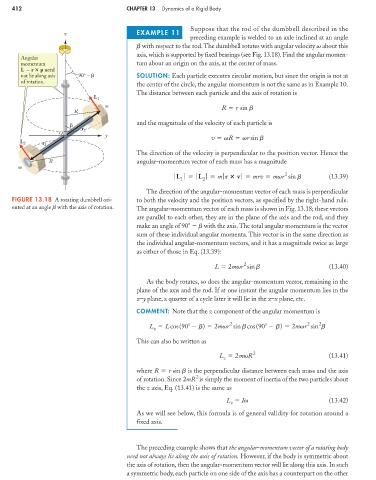
                                                                      Suppose that the rod of the dumbbell described in the
                                z                     EXAMPLE 11
                                                                      preceding example is welded to an axle inclined at an angle
                                                      	 with respect to the rod.The dumbbell rotates with angular velocity   about this
                                                      axis, which is supported by fixed bearings (see Fig. 13.18). Find the angular momen-
                   Angular
                   momentum                           tum about an origin on the axis, at the center of mass.
                   L   r   p need
                   not lie along axis  90° –          SOLUTION: Each particle executes circular motion, but since the origin is not at
                   of rotation.
                                                      the center of the circle, the angular momentum is not the same as in Example 10.
                                                      The distance between each particle and the axis of rotation is
                                         L 1
                                            m                                   R   r  sin
                                   R

                                                      and the magnitude of the velocity of each particle is
                                     r r 1
                              O O
                                            y                               v    R    r sin
                  L 2    r r 2 2 2
                                                      The direction of the velocity is perpendicular to the position vector. Hence the
                           R                          angular-momentum vector of each mass has a magnitude
                  m
                                                                                                   2
                                                                 ƒ L ƒ   ƒ L ƒ   m ƒ r   v ƒ   mrv   m r  sin 	  (13.39)
                                                                   1      2
                                                         The direction of the angular-momentum vector of each mass is perpendicular
                FIGURE 13.18 A rotating dumbbell ori-  to both the velocity and the position vectors, as specified by the right-hand rule.
                ented at an angle 	 with the axis of rotation.  The angular-momentum vector of each mass is shown in Fig. 13.18; these vectors
                                                      are parallel to each other, they are in the plane of the axis and the rod, and they
                                                      make an angle of 90   	 with the axis.The total angular momentum is the vector
                                                      sum of these individual angular momenta. This vector is in the same direction as
                                                      the individual angular-momentum vectors, and it has a magnitude twice as large
                                                      as either of those in Eq. (13.39):
                                                                                      2
                                                                              L   2m r  sin 	                   (13.40)
                                                         As the body rotates, so does the angular-momentum vector, remaining in the
                                                      plane of the axis and the rod. If at one instant the angular momentum lies in the
                                                      z–y plane, a quarter of a cycle later it will lie in the z–x plane, etc.
                                                      COMMENT: Note that the z component of the angular momentum is
                                                                                  2
                                                                                                             2
                                                                                                          2
                                                          L   L cos(90   	)   2m r sin 	 cos(90   	)   2m r  sin
                                                           z
                                                      This can also be written as
                                                                                         2
                                                                               L   2m
R                         (13.41)
                                                                                z
                                                      where R   r sin 	 is the perpendicular distance between each mass and the axis
                                                                        2
                                                      of rotation. Since 2mR is simply the moment of inertia of the two particles about
                                                      the z axis, Eq. (13.41) is the same as

                                                                                 L   I                          (13.42)
                                                                                  z
                                                      As we will see below, this formula is of general validity for rotation around a
                                                      fixed axis.


                                                      The preceding example shows that the angular-momentum vector of a rotating body
                                                   need not always lie along the axis of rotation. However, if the body is symmetric about
                                                   the axis of rotation, then the angular-momentum vector will lie along this axis. In such
                                                   a symmetric body, each particle on one side of the axis has a counterpart on the other

