


Page 214 - Fisika Terapan for Engineers and Scientists
P. 214
414                                CHAPTER 13  Dynamics of a Rigid Body


                  PHYSICS IN PRACTICE              THE GYROCOMPASS


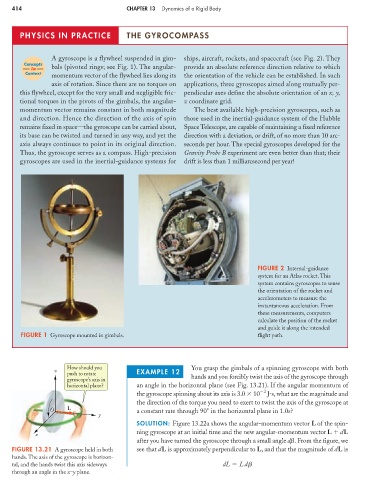
                            A gyroscope is a flywheel suspended in gim-  ships, aircraft, rockets, and spacecraft (see Fig. 2). They
                    Concepts
                      in    bals (pivoted rings; see Fig. 1). The angular-  provide an absolute reference direction relative to which
                    Context
                            momentum vector of the flywheel lies along its  the orientation of the vehicle can be established. In such
                            axis of rotation. Since there are no torques on  applications, three gyroscopes aimed along mutually per-
                  this flywheel, except for the very small and negligible fric-  pendicular axes define the absolute orientation of an x, y,
                  tional torques in the pivots of the gimbals, the angular-  z coordinate grid.
                  momentum vector remains constant in both magnitude   The best available high-precision gyroscopes, such as
                  and direction. Hence the direction of the axis of spin  those used in the inertial-guidance system of the Hubble
                  remains fixed in space—the gyroscope can be carried about,  Space Telescope, are capable of maintaining a fixed reference
                  its base can be twisted and turned in any way, and yet the  direction with a deviation, or drift, of no more than 10 arc-
                  axis always continues to point in its original direction.  seconds per hour. The special gyroscopes developed for the
                  Thus, the gyroscope serves as a compass. High-precision  Gravity Probe B experiment are even better than that; their
                  gyroscopes are used in the inertial-guidance systems for  drift is less than 1 milliarcsecond per year!


                                                                                           FIGURE 2 Internal-guidance
                                                                                           system for an Atlas rocket. This
                                                                                           system contains gyroscopes to sense
                                                                                           the orientation of the rocket and
                                                                                           accelerometers to measure the
                                                                                           instantaneous acceleration. From
                                                                                           these measurements, computers
                                                                                           calculate the position of the rocket
                                                                                           and guide it along the intended
                   FIGURE 1 Gyroscope mounted in gimbals.                                  flight path.


                                 How should you                       You grasp the gimbals of a spinning gyroscope with both
                             z                        EXAMPLE 12
                                 push to rotate
                                 gyroscope’s axis in                  hands and you forcibly twist the axis of the gyroscope through
                                 horizontal plane?    an angle in the horizontal plane (see Fig. 13.21). If the angular momentum of
                                                      the gyroscope spinning about its axis is 3.0   10  2  J s, what are the magnitude and
                                                      the direction of the torque you need to exert to twist the axis of the gyroscope at
                            O    L                    a constant rate through 90  in the horizontal plane in 1.0s?
                                          y
                                                      SOLUTION: Figure 13.22a shows the angular-momentum vector L of the spin-
                                                      ning gyroscope at an initial time and the new angular-momentum vector L   dL
                       x
                                                      after you have turned the gyroscope through a small angle d	. From the figure, we
                FIGURE 13.21 A gyroscope held in both  see that dL is approximately perpendicular to L, and that the magnitude of dL is
                hands. The axis of the gyroscope is horizon-
                tal, and the hands twist this axis sideways                     dL   Ld
                through an angle in the x–y plane.

