


Page 213 - Fisika Terapan for Engineers and Scientists
P. 213
13.4  Torque and Angular Momentum as Vectors                      413


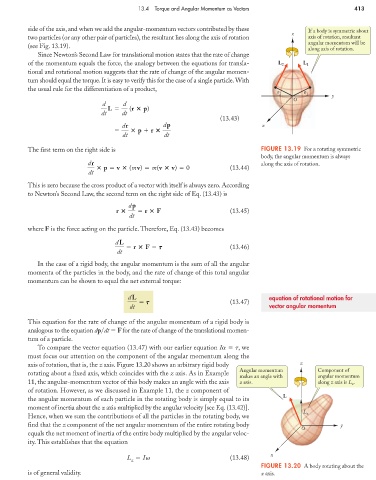
                     side of the axis, and when we add the angular-momentum vectors contributed by these  If a body is symmetric about
                                                                                                     z
                     two particles (or any other pair of particles), the resultant lies along the axis of rotation  axis of rotation, resultant
                                                                                                          angular momentum will be
                     (see Fig. 13.19).
                                                                                                          along axis of rotation.
                        Since Newton’s Second Law for translational motion states that the rate of change
                     of the momentum equals the force, the analogy between the equations for transla-  L 2  L 1
                     tional and rotational motion suggests that the rate of change of the angular momen-
                     tum should equal the torque. It is easy to verify this for the case of a single particle.With
                     the usual rule for the differentiation of a product,
                                                                                                r r 2 2  r 1     y
                                                                                                     O O
                                           d      d
                                             L      (r   p)
                                           dt    dt
                                                                               (13.43)
                                                 dr           dp                            x
                                                      p   r
                                                  dt          dt
                     The first term on the right side is                                    FIGURE 13.19 For a rotating symmetric
                                                                                            body, the angular momentum is always
                                       dr                                                   along the axis of rotation.
                                            p   v   (mv)   m(v   v)   0           (13.44)
                                       dt
                     This is zero because the cross product of a vector with itself is always zero. According
                     to Newton’s Second Law, the second term on the right side of Eq. (13.43) is
                                                   dp
                                                r       r   F                     (13.45)
                                                    dt
                     where F is the force acting on the particle. Therefore, Eq. (13.43) becomes

                                               d L
                                                     r   F                        (13.46)
                                                dt
                        In the case of a rigid body, the angular momentum is the sum of all the angular
                     momenta of the particles in the body, and the rate of change of this total angular
                     momentum can be shown to equal the net external torque:

                                                   d L                                        equation of rotational motion for
                                                                                  (13.47)
                                                    dt                                        vector angular momentum

                     This equation for the rate of change of the angular momentum of a rigid body is
                     analogous to the equation dp dt   F for the rate of change of the translational momen-
                     tum of a particle.
                        To compare the vector equation (13.47) with our earlier equation I     ,we
                     must focus our attention on the component of the angular momentum along the
                     axis of rotation, that is, the z axis. Figure 13.20 shows an arbitrary rigid body  z
                                                                                     Angular momentum        Component of
                     rotating about a fixed axis, which coincides with the z axis. As in Example
                                                                                     makes an angle with     angular momentum
                     11, the angular-momentum vector of this body makes an angle with the axis  z axis.      along z axis is L .
                                                                                                                       z
                     of rotation. However, as we discussed in Example 11, the z component of
                                                                                                  L
                     the angular momentum of each particle in the rotating body is simply equal to its
                     moment of inertia about the z axis multiplied by the angular velocity [see Eq. (13.42)].
                                                                                                        L z
                     Hence, when we sum the contributions of all the particles in the rotating body, we
                     find that the z component of the net angular momentum of the entire rotating body              y
                                                                                                        O
                     equals the net moment of inertia of the entire body multiplied by the angular veloc-
                     ity. This establishes that the equation

                                                   L   I                          (13.48)     x
                                                    z
                                                                                            FIGURE 13.20 A body rotating about the
                     is of general validity.                                                z axis.

