


Page 22 - Fisika Terapan for Engineers and Scientists
P. 22
222                                CHAPTER 7  Work and Energy


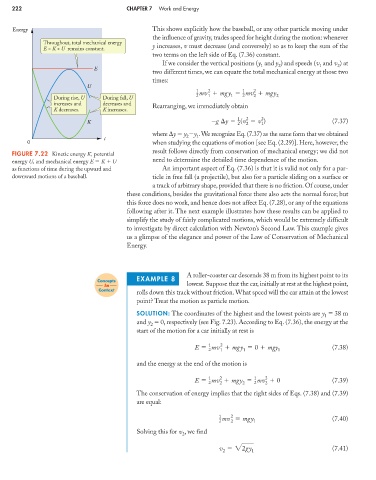
                Energy                                     This shows explicitly how the baseball, or any other particle moving under
                                                           the influence of gravity, trades speed for height during the motion: whenever
                          Throughout, total mechanical energy
                          E = K + U  remains constant.     y increases, v must decrease (and conversely) so as to keep the sum of the
                                                           two terms on the left side of Eq. (7.36) constant.
                                                              If we consider the vertical positions (y and y ) and speeds (v and v ) at
                                                                                           1
                                                                                                 2
                                                                                                             1
                                                                                                                   2
                                         E
                                                           two different times, we can equate the total mechanical energy at those two
                                                           times:
                                       U
                                                                        1  2          1  2
                                                                         mv    mg y   mv   mg y
                             During rise, U  During fall, U             2   1     1   2   2     2
                             increases and  decreases and  Rearranging, we immediately obtain
                             K decreases.   K increases.
                                                                                            2
                                                                                    1
                                                                                       2
                                       K                                     g ¢y   (v   v )                     (7.37)
                                                                                    2   2   1
                                                           where  y   y  y .We recognize Eq. (7.37) as the same form that we obtained
                                                                        1
                                                                     2
                                            t
                     0                                     when studying the equations of motion [see Eq. (2.29)]. Here, however, the
                                                           result follows directly from conservation of mechanical energy; we did not
                FIGURE 7.22 Kinetic energy K, potential
                energy U, and mechanical energy E   K   U  need to determine the detailed time dependence of the motion.
                as functions of time during the upward and    An important aspect of Eq. (7.36) is that it is valid not only for a par-
                downward motions of a baseball.            ticle in free fall (a projectile), but also for a particle sliding on a surface or
                                                           a track of arbitrary shape, provided that there is no friction. Of course, under
                                                   these conditions, besides the gravitational force there also acts the normal force; but
                                                   this force does no work, and hence does not affect Eq. (7.28), or any of the equations
                                                   following after it. The next example illustrates how these results can be applied to
                                                   simplify the study of fairly complicated motions, which would be extremely difficult
                                                   to investigate by direct calculation with Newton’s Second Law. This example gives
                                                   us a glimpse of the elegance and power of the Law of Conservation of Mechanical
                                                   Energy.


                                                                     A roller-coaster car descends 38 m from its highest point to its
                                          Concepts    EXAMPLE 8
                                            in                       lowest. Suppose that the car, initially at rest at the highest point,
                                          Context
                                                      rolls down this track without friction. What speed will the car attain at the lowest
                                                      point? Treat the motion as particle motion.
                                                      SOLUTION: The coordinates of the highest and the lowest points are y   38 m
                                                                                                               1
                                                      and y   0, respectively (see Fig. 7.23). According to Eq. (7.36), the energy at the
                                                          2
                                                      start of the motion for a car initially at rest is
                                                                               2
                                                                            1
                                                                       E   mv    mg y   0   mgy                  (7.38)
                                                                            2   1     1          1
                                                      and the energy at the end of the motion is

                                                                                         1
                                                                                             2
                                                                            1
                                                                               2
                                                                       E   mv   mg y   mv   0                    (7.39)
                                                                            2   2     2  2   2
                                                      The conservation of energy implies that the right sides of Eqs. (7.38) and (7.39)
                                                      are equal:
                                                                               1  2
                                                                                mv    mg y                       (7.40)
                                                                               2   2     1
                                                      Solving this for v , we find
                                                                    2
                                                                               v   22g y                         (7.41)
                                                                                2        1

