


Page 19 - Fisika Terapan for Engineers and Scientists
P. 19
7.4  Gravitational Potential Energy                     219


                     the particle.Thus, a particle high above the surface is endowed with a large amount of
                     latent work, which can be exploited and converted into actual work by allowing the
                     particle to push against some obstacle as it descends. A good example of such an
                     exploitation of gravitational potential energy is found in a grandfather clock, where a
                     weight hanging on a cord drives the wheel of the clock (Fig. 7.19). The weight does
                     work on the wheel, and gradually converts all of its gravitational potential energy into
                     work as it descends (in a typical grandfather clock, the weight takes about a week to
                     sink down from the top to the bottom, and you must then rewind the clock, by lifting
                     the weight).
                        To obtain a general expression for the gravitational potential energy of a particle
                     moving on a straight or a curving path, we first consider a particle moving on an
                     inclined plane. According to Eq. (7.11), when a particle of mass m descends a distance
                     h along an inclined plane, the work done by gravity is
                                                   W   mgh                         (7.27)

                        As already remarked on in Example 3, this result is independent of the angle of
                     inclination of the plane—it depends only on the change of height. More generally, for
                     a curved path, the result is independent of the shape of the path that the particle fol-
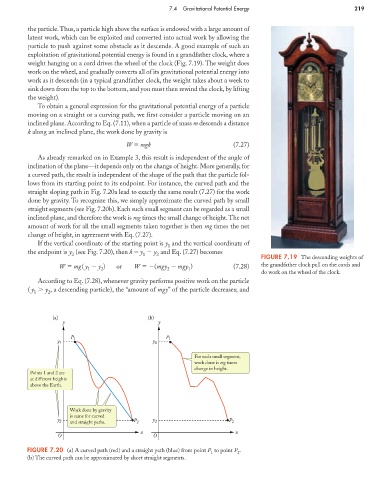
                     lows from its starting point to its endpoint. For instance, the curved path and the
                     straight sloping path in Fig. 7.20a lead to exactly the same result (7.27) for the work
                     done by gravity. To recognize this, we simply approximate the curved path by small
                     straight segments (see Fig. 7.20b). Each such small segment can be regarded as a small
                     inclined plane, and therefore the work is mg times the small change of height.The net
                     amount of work for all the small segments taken together is then mg times the net
                     change of height, in agreement with Eq. (7.27).
                        If the vertical coordinate of the starting point is y and the vertical coordinate of
                                                               1
                     the endpoint is y (see Fig. 7.20), then h   y   y and Eq. (7.27) becomes
                                  2                     1   2
                                                                                            FIGURE 7.19 The descending weights of
                              W   mg( y   y )   or   W   (mgy   mgy )              (7.28)   the grandfather clock pull on the cords and
                                       1   2                   2     1
                                                                                            do work on the wheel of the clock.
                        According to Eq. (7.28), whenever gravity performs positive work on the particle
                     ( y
 y , a descending particle), the “amount of mgy” of the particle decreases; and
                       1   2


                            (a)                          (b)
                               y                            y

                                  P 1                          P 1
                              y 1                          y 1

                                                                       For each small segment,
                                                                       work done is mg times
                                                                       change in height.
                      Points 1 and 2 are
                      at different heights
                      above the Earth.


                                  Work done by gravity
                                  is same for curved
                              y 2                          y 2
                                  and straight paths.  P 2                        P 2
                                                       x                            x
                              O                            O
                     FIGURE 7.20 (a) A curved path (red) and a straight path (blue) from point P to point P .
                                                                                    2
                                                                            1
                     (b) The curved path can be approximated by short straight segments.

