


Page 17 - Fisika Terapan for Engineers and Scientists
P. 17
7.3  Kinetic Energy                           217


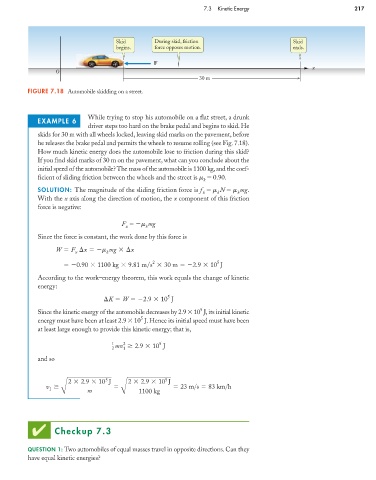
                                                Skid       During skid, friction                     Skid
                                                begins.    force opposes motion.                     ends.

                                                           F
                                                                                                           x
                             O
                                                                         30 m
                     FIGURE 7.18 Automobile skidding on a street.


                                       While trying to stop his automobile on a flat street, a drunk
                        EXAMPLE 6
                                       driver steps too hard on the brake pedal and begins to skid. He
                        skids for 30 m with all wheels locked, leaving skid marks on the pavement, before
                        he releases the brake pedal and permits the wheels to resume rolling (see Fig. 7.18).
                        How much kinetic energy does the automobile lose to friction during this skid?
                        If you find skid marks of 30 m on the pavement, what can you conclude about the
                        initial speed of the automobile? The mass of the automobile is 1100 kg, and the coef-
                        ficient of sliding friction between the wheels and the street is     0.90.
                                                                          k
                        SOLUTION: The magnitude of the sliding friction force is f     N     mg.
                                                                          k   k     k
                        With the x axis along the direction of motion, the x component of this friction
                        force is negative:

                                                 F     mg
                                                  x      k
                        Since the force is constant, the work done by this force is
                               W   F  ¢x   m mg   ¢x
                                   x         k
                                                           2                  5
                                 0.90   1100 kg   9.81 m s   30 m   2.9   10 J
                        According to the work–energy theorem, this work equals the change of kinetic
                        energy:
                                                               5
                                            ¢K   W   2.9   10  J
                                                                         5
                        Since the kinetic energy of the automobile decreases by 2.9 10 J, its initial kinetic
                                                       5
                        energy must have been at least 2.9   10 J. Hence its initial speed must have been
                        at least large enough to provide this kinetic energy; that is,
                                              1   2          5
                                              2  mv   2.9   10  J
                                                  1
                        and so


                                            5
                                                              5
                                 2   2.9   10 J    2   2.9   10 J
                          v    B       m          B   1100 kg      23 m>s   83 km>h
                           1


                      ✔      Checkup 7.3


                     QUESTION 1: Two automobiles of equal masses travel in opposite directions. Can they
                     have equal kinetic energies?

