


Page 252 - Fisika Terapan for Engineers and Scientists
P. 252
452                                CHAPTER 14  Statics and Elasticity


                  7. A carpenter wants to support the (flat) roof of a building with  8. The long bones in the limbs of vertebrates have the shape of
                     horizontal beams of wood of rectangular cross section. To  hollow pipes. If the same amount of bone tissue had been
                     achieve maximum strength of the roof (least sag), should he  assembled in a solid rod (of correspondingly smaller cross
                     install the beams with their narrow side up or with their wide  section), would the limb have been more rigid or less rigid?
                     side up?


                PROBLEMS


                4.2 Examples of Static Equilibrium                     3. Consider the bridge with the locomotive described in
                                                                         Example 1 and suppose that, besides the first locomotive at
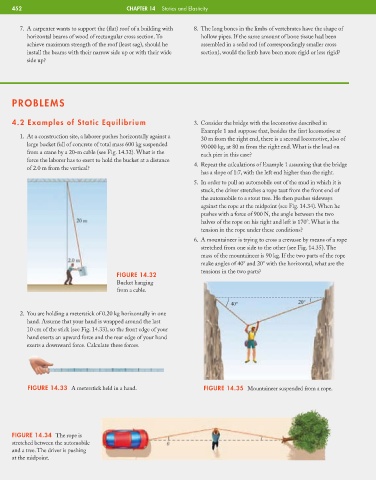
                  1. At a construction site, a laborer pushes horizontally against a
                                                                         30 m from the right end, there is a second locomotive, also of
                     large bucket full of concrete of total mass 600 kg suspended
                                                                         90000 kg, at 80 m from the right end. What is the load on
                     from a crane by a 20-m cable (see Fig. 14.32). What is the
                                                                         each pier in this case?
                     force the laborer has to exert to hold the bucket at a distance
                                                                       4. Repeat the calculations of Example 1 assuming that the bridge
                     of 2.0 m from the vertical?
                                                                         has a slope of 1:7, with the left end higher than the right.
                                                                       5. In order to pull an automobile out of the mud in which it is
                                                                         stuck, the driver stretches a rope taut from the front end of
                                                                         the automobile to a stout tree. He then pushes sideways
                                                                         against the rope at the midpoint (see Fig. 14.34). When he
                                                                         pushes with a force of 900 N, the angle between the two
                                                                         halves of the rope on his right and left is 170 . What is the
                                                                         tension in the rope under these conditions?
                                                                       6. A mountaineer is trying to cross a crevasse by means of a rope
                                                                         stretched from one side to the other (see Fig. 14.35). The
                                                                         mass of the mountaineer is 90 kg. If the two parts of the rope
                                                                         make angles of 40  and 20  with the horizontal, what are the
                                                                         tensions in the two parts?
                                                FIGURE 14.32
                                                Bucket hanging
                                                from a cable.
                                                                                  40°                  20°
                  2. You are holding a meterstick of 0.20 kg horizontally in one
                     hand. Assume that your hand is wrapped around the last
                     10 cm of the stick (see Fig. 14.33), so the front edge of your
                     hand exerts an upward force and the rear edge of your hand
                     exerts a downward force. Calculate these forces.


                     FIGURE 14.33 A meterstick held in a hand.            FIGURE 14.35 Mountaineer suspended from a rope.


                FIGURE 14.34 The rope is
                stretched between the automobile
                and a tree. The driver is pushing
                at the midpoint.

