


Page 249 - Fisika Terapan for Engineers and Scientists
P. 249
14.4  Elasticity of Materials                      449


                                       What pressure must you exert on a sample of water if you want
                        EXAMPLE 9
                                       to compress its volume by 0.10%?
                        SOLUTION: For volume compression, the relevant elastic modulus is the bulk
                        modulus B. By Eq. (14.20), the pressure, or the force per unit area, is
                                                 F       ¢V
                                                     B
                                                 A       V
                        For 0.10% compression, we want to achieve a fractional change of volume of
                                                                              10    2
                        	V V   0.0010. Since the bulk modulus of water is 0.22   10  N/m , the
                        required pressure is
                                 F           10    2                  6    2
                                     0.22   10
/m   0.0010   2.2   10
/m
                                 A


                        The simple uniform deformations of elongation, shear, and compression described
                     above require a rather special arrangement of forces. In general, the forces applied to
                     a solid body will produce nonuniform elongation, shear, and compression. For instance,
                     a beam supported at its ends and sagging in the middle because of its own weight or
                     the weight of a load placed on it will elongate along its lower edge, and compress along
                     its upper edge.
                        Finally, note that the formulas (14.18)–(14.20) are valid only as long as the defor-
                     mation is reasonably small—a fraction of a percent or so. If the deformation is exces-
                     sive, the material will be deformed beyond its elastic limit; that is, the material will
                     suffer a permanent deformation and will not return to its original size and shape when
                     the force ceases. If the deformation is even larger, the material will break apart or crum-
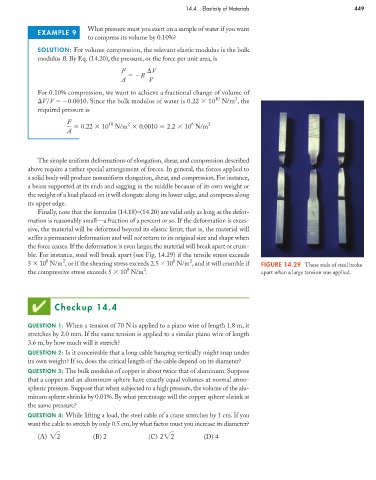
                     ble. For instance, steel will break apart (see Fig. 14.29) if the tensile stress exceeds
                          8    2                                 8    2
                     5   10 N/m , or if the shearing stress exceeds 2.5   10 N/m , and it will crumble if  FIGURE 14.29 These rods of steel broke
                                                   8    2
                     the compressive stress exceeds 5   10 N/m .                            apart when a large tension was applied.


                      ✔      Checkup 14.4


                     QUESTION 1: When a tension of 70 N is applied to a piano wire of length 1.8 m, it
                     stretches by 2.0 mm. If the same tension is applied to a similar piano wire of length
                     3.6 m, by how much will it stretch?
                     QUESTION 2: Is it conceivable that a long cable hanging vertically might snap under
                     its own weight? If so, does the critical length of the cable depend on its diameter?
                     QUESTION 3: The bulk modulus of copper is about twice that of aluminum. Suppose
                     that a copper and an aluminum sphere have exactly equal volumes at normal atmo-
                     spheric pressure. Suppose that when subjected to a high pressure, the volume of the alu-
                     minum sphere shrinks by 0.01%. By what percentage will the copper sphere shrink at
                     the same pressure?
                     QUESTION 4: While lifting a load, the steel cable of a crane stretches by 1 cm. If you
                     want the cable to stretch by only 0.5 cm, by what factor must you increase its diameter?

                        (A)  22          (B) 2           (C) 222          (D) 4

