


Page 248 - Fisika Terapan for Engineers and Scientists
P. 248
448                                CHAPTER 14  Statics and Elasticity


                                                   Table 14.1 includes values of bulk moduli for solids.This table also includes values of
                                                   bulk moduli for some liquids.The force per unit area,F A, is also known as the pressure:
                                                                                         F
                                      pressure                                [pressure]                        (14.21)
                                                                                         A
                                                   The formula (14.20) is equally valid for solids and for liquids—when we squeeze a
                                                   liquid from all sides, it will suffer a compression. Note that Table 14.1 does not include
                                                   values of Young’s moduli and of shear moduli for liquids. Elongation and shear stress
                                                   are not supported by a liquid—we can elongate or shear a “block” of liquid as much as
                                                   we please without having to exert any significant force.


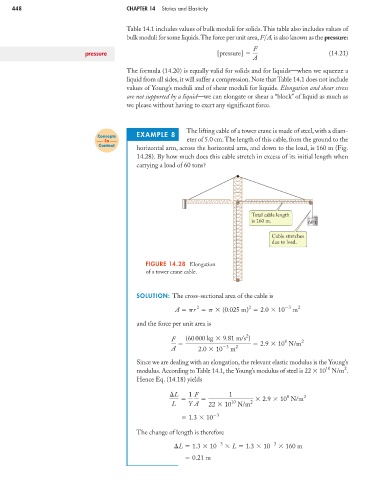
                                                                     The lifting cable of a tower crane is made of steel, with a diam-
                                          Concepts    EXAMPLE 8
                                            in                       eter of 5.0 cm.The length of this cable, from the ground to the
                                          Context
                                                      horizontal arm, across the horizontal arm, and down to the load, is 160 m (Fig.
                                                      14.28). By how much does this cable stretch in excess of its initial length when
                                                      carrying a load of 60 tons?


                                                                                         Total cable length
                                                                                         is 160 m.        60 t

                                                                                               Cable stretches
                                                                                               due to load.


                                                         FIGURE 14.28 Elongation
                                                         of a tower crane cable.


                                                      SOLUTION: The cross-sectional area of the cable is
                                                                                        2
                                                                                                    3
                                                                        2
                                                                  A   pr   p   (0.025 m)   2.0   10  m 2
                                                      and the force per unit area is
                                                                                       2
                                                                F    (60   000 kg   9.81 m/s )     8    2
                                                                                           2.9   10  N/m
                                                                                 3
                                                                A       2.0   10  m 2
                                                      Since we are dealing with an elongation, the relevant elastic modulus is the Young’s
                                                                                                               10
                                                                                                                     2
                                                      modulus. According to Table 14.1, the Young’s modulus of steel is 22   10 N/m .
                                                      Hence Eq. (14.18) yields
                                                                ¢L    1 F         1                8    2
                                                                                            2.9   10  N/m
                                                                                   10
                                                                L     Y A   22   10  N/m 2
                                                                      1.3   10  3

                                                      The change of length is therefore
                                                                               3               3
                                                                  ¢L   1.3   10    L   1.3   10    160 m
                                                                       0.21 m

