


Page 46 - Fisika Terapan for Engineers and Scientists
P. 46
246                                CHAPTER 8  Conservation of Energy


                                                                     Some fanatics, in search of dangerous thrills, jump off high
                                                      EXAMPLE 4
                                                                     bridges or towers with bungee cords (long rubber cords) tied
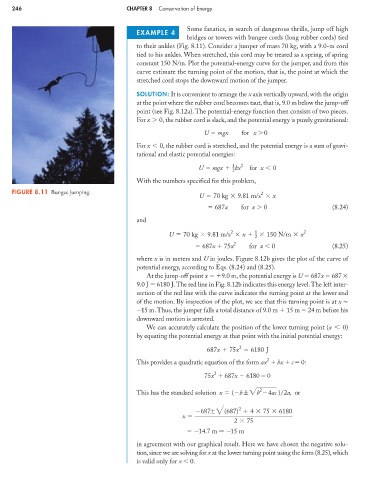
                                                      to their ankles (Fig. 8.11). Consider a jumper of mass 70 kg, with a 9.0-m cord
                                                      tied to his ankles. When stretched, this cord may be treated as a spring, of spring
                                                      constant 150 N/m. Plot the potential-energy curve for the jumper, and from this
                                                      curve estimate the turning point of the motion, that is, the point at which the
                                                      stretched cord stops the downward motion of the jumper.

                                                      SOLUTION: It is convenient to arrange the x axis vertically upward, with the origin
                                                      at the point where the rubber cord becomes taut, that is, 9.0 m below the jump-off
                                                      point (see Fig. 8.12a). The potential-energy function then consists of two pieces.
                                                      For x   0, the rubber cord is slack, and the potential energy is purely gravitational:
                                                                          U   mgx     for x  0
                                                      For x 	 0, the rubber cord is stretched, and the potential energy is a sum of gravi-
                                                      tational and elastic potential energies:
                                                                                   1
                                                                                     2
                                                                         U   mgx   kx    for  x 	 0
                                                                                   2
                                                      With the numbers specified for this problem,
                FIGURE 8.11 Bungee jumping.                                                2
                                                                           U   70 kg   9.81 m/s   x
                                                                             687x    for x   0                   (8.24)

                                                      and
                                                                                  2       1             2
                                                                U   70 kg   9.81 m/s   x     150 N/m   x
                                                                                          2
                                                                                   2
                                                                          687x   75x    for x 	 0                (8.25)
                                                      where x is in meters and U in joules. Figure 8.12b gives the plot of the curve of
                                                      potential energy, according to Eqs. (8.24) and (8.25).
                                                         At the jump-off point x   9.0 m, the potential energy is U   687x   687
                                                      9.0 J   6180 J.The red line in Fig. 8.12b indicates this energy level.The left inter-
                                                      section of the red line with the curve indicates the turning point at the lower end
                                                      of the motion. By inspection of the plot, we see that this turning point is at x
                                                       15 m.Thus, the jumper falls a total distance of 9.0 m   15 m   24 m before his
                                                      downward motion is arrested.
                                                         We can accurately calculate the position of the lower turning point (x 	 0)
                                                      by equating the potential energy at that point with the initial potential energy:

                                                                                     2
                                                                           687x   75x   6180  J
                                                                                             2
                                                      This provides a quadratic equation of the form ax   bx   c   0:
                                                                             2
                                                                          75x   687x   6180   0

                                                                                           2
                                                      This has the standard solution  x   ( b ; 2b  4ac ) 2a,  or
                                                                                     2
                                                                         687;  3 (687)   4   75   6180
                                                                    x
                                                                                   2   75
                                                                       14.7 m    15 m
                                                      in agreement with our graphical result. Here we have chosen the negative solu-
                                                      tion, since we are solving for x at the lower turning point using the form (8.25), which
                                                      is valid only for x 	 0.

