


Page 60 - Fisika Terapan for Engineers and Scientists
P. 60
260                                CHAPTER 8  Conservation of Energy


                SI UNIT OF POWER                                       1 watt   1 W   1 J/s

                AVERAGE POWER                                               ¢W                                   (8.33)
                                                                       P
                                                                            ¢t

                INSTANTANEOUS POWER                                    P    dW                                   (8.34)
                                                                            dt

                MECHANICAL POWER DELIVERED BY A FORCE                  P   F v   Fv cos                      (8.43; 8.44)


                WORK DONE AT CONSTANT POWER                             W   P ¢t                                 (8.37)


                WORK DONE WITH TIME-DEPENDENT POWER                          t 2                                 (8.38)
                                                                       W      P dt

                                                                            t 1


                QUESTIONS FOR DISCUSSION

                  1. A body slides on a smooth horizontal plane. Is the normal  10. Since mass is a form of energy, why don’t we measure mass in
                    force of the plane on the body a conservative force? Can we  the same units as energy? How could we do this?
                    define a potential energy for this force according to the recipe  11. In order to travel at 130 km/h, an automobile of average size
                    in Section 8.1?                                      needs an engine delivering about 40 hp to overcome the
                  2. If you stretch a spring so far that it suffers a permanent defor-  effects of air friction, road friction, and internal friction (in the
                    mation, is the force exerted by the spring during this operation  transmission and drive train). Why do most drivers think they
                    conservative?                                        need an engine of 150 or 200 hp?
                  3. Is there any frictional dissipation of mechanical energy in the
                    motion of the planets of the Solar System or in the motion of
                    their satellites? (Hint: Consider the tides.)
                  4. What happens to the kinetic energy of an automobile during
                    braking without skidding? With skidding?
                  5. An automobile travels down a road leading from a mountain
                    peak to a valley. What happens to the gravitational potential
                    energy of the automobile? How is it dissipated?
                  6. Suppose you wind up a watch and then place it into a beaker
                    full of nitric acid and let it dissolve. What happens to the
                    potential energy stored in the spring of the watch?
                  7. News reporters commonly speak of “energy consumption.” Is
                    it accurate to say that energy is consumed? Would it be more
                    accurate to say that energy is dissipated ?
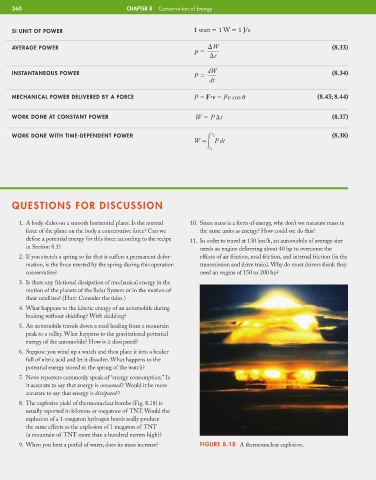
                  8. The explosive yield of thermonuclear bombs (Fig. 8.18) is
                    usually reported in kilotons or megatons of TNT. Would the
                    explosion of a 1-megaton hydrogen bomb really produce
                    the same effects as the explosion of 1 megaton of TNT
                    (a mountain of TNT more than a hundred meters high)?
                  9. When you heat a potful of water, does its mass increase?  FIGURE 8.18 A thermonuclear explosion.

