


Page 74 - Fisika Terapan for Engineers and Scientists
P. 74
274                                CHAPTER 9  Gravitation


                                                      The gravitational force does not require any contact between the interacting par-
                                                   ticles. In reaching from one remote particle to another, the gravitational force some-
                                                   how bridges the empty space between the particles.This is called action-at-a-distance.
                                                      It is also quite remarkable that the gravitational force between two particles is
                                                   unaffected by the presence of intervening masses. For example, a particle in Washington
                                                   attracts a particle in Beijing with exactly the force given by Eq. (9.1), even though all
                                                   of the bulk of the Earth lies between Washington and Beijing. This means that it is
                                                   impossible to shield a particle from the gravitational attraction of another particle.
                                                      Since the gravitational attraction between two particles is completely independent
                                                   of the presence of other particles, it follows that the net gravitational force between
                                                   two bodies (e.g., the Earth and the Moon or the Earth and an apple) is merely the
                                                   vector sum of the individual forces between all the particles making up the bodies—
                                                   that is, the gravitational force obeys the principle of linear superposition of forces (see
                                                   Section 5.3). As a consequence of this simple vector summation of the gravitational forces
                                                   of the individual particles in a body, it can be shown that the net gravitational force
                                                   between two spherical bodies acts just as though each body were concentrated at the center of
                               Newton’s theorem    its respective sphere.This result is known as Newton’s theorem.The proof of Newton’s
                                                   theorem involves a somewhat tedious summation. Later, in the context of electrostatic
                                                   force, we provide a much simpler derivation of Newton’s theorem using Gauss’ Law (see
                                                   Chapter 24). Since the Sun, the planets, and most of their satellites are almost exactly
                                                   spherical, this important theorem permits us to treat all these celestial bodies as point-
                                                   like particles in all calculations concerning their gravitational attractions. For instance,
                                                   since the Earth is (nearly) spherical, the gravitational force exerted by the Earth on a
                                                   particle above its surface is as though the mass of the Earth were concentrated at its
                                                   center; thus, this force has a magnitude

                                                                                    GM m
                         A spherical body attracts                             F       E                          (9.3)
                         as though its mass were                                      r 2
                         concentrated at its center.
                                                   where m is the mass of the particle, M is the mass of the Earth, and r is the distance
                                                                                 E
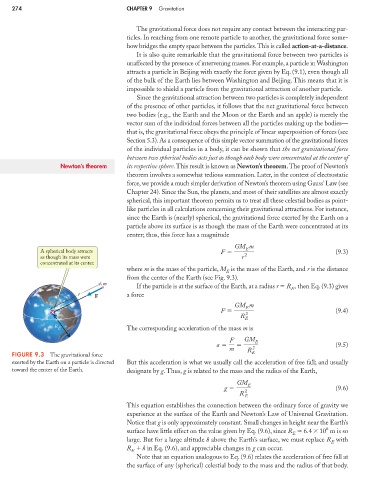
                                                   from the center of the Earth (see Fig. 9.3).
                                            m
                                                      If the particle is at the surface of the Earth, at a radius r   R , then Eq. (9.3) gives
                                                                                                     E
                                    r    F         a force
                                                                                    GM m
                                                                               F       E                          (9.4)
                                                                                       2
                                                                                     R E
                             R E                   The corresponding acceleration of the mass m is
                                                                                  F   GM  E
                                                                              a                                   (9.5)
                                                                                  m    R 2
                FIGURE 9.3  The gravitational force                                      E
                exerted by the Earth on a particle is directed  But this acceleration is what we usually call the acceleration of free fall; and usually
                toward the center of the Earth.    designate by g. Thus, g is related to the mass and the radius of the Earth,

                                                                                    GM E
                                                                                g                                 (9.6)
                                                                                       2
                                                                                     R
                                                                                       E
                                                   This equation establishes the connection between the ordinary force of gravity we
                                                   experience at the surface of the Earth and Newton’s Law of Universal Gravitation.
                                                   Notice that g is only approximately constant. Small changes in height near the Earth’s
                                                                                                               6
                                                   surface have little effect on the value given by Eq. (9.6), since R ≈ 6.4   10 m is so
                                                                                                     E
                                                   large. But for a large altitude h above the Earth’s surface, we must replace R with
                                                                                                                 E
                                                   R   h in Eq. (9.6), and appreciable changes in g can occur.
                                                    E
                                                      Note that an equation analogous to Eq. (9.6) relates the acceleration of free fall at
                                                   the surface of any (spherical) celestial body to the mass and the radius of that body.

