


Page 78 - Fisika Terapan for Engineers and Scientists
P. 78
278                                CHAPTER 9  Gravitation


                                                    ✔      Checkup 9.2


                                                   QUESTION 1: Why don’t we determine G by measuring the (fairly large) force between
                                                   the Earth and a mass of, say, 1 kg?
                                                   QUESTION 2: Large mountains produce a (small) deflection of a plumb bob suspended
                                                   nearby. Could we use this effect to determine G?
                                                      (A) Yes          (B) No


                  Online                           9.3 CIRCULAR ORBITS
                 11
                Concept
                 Tutorial                          The gravitational force is responsible for holding the Solar System together; it makes
                                                   the planets orbit around the Sun, and it makes the satellites orbit around the planets.
                                                   Although the mutual gravitational forces of the Sun on a planet and of the planet on the
                                                   Sun are of equal magnitudes, the mass of the Sun is more than a thousand times as
                                                   large as the mass of even the largest planet, and hence its acceleration is much smaller.
                    Gravitational force provides
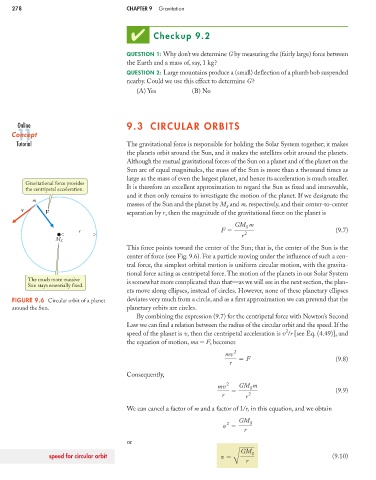
                    the centripetal acceleration.  It is therefore an excellent approximation to regard the Sun as fixed and immovable,
                                                   and it then only remains to investigate the motion of the planet. If we designate the
                      m
                                                   masses of the Sun and the planet by M and m, respectively, and their center-to-center
                                                                                 S
                   v      F                        separation by r, then the magnitude of the gravitational force on the planet is
                                                                                    GM m
                                                                                       S
                                    r                                          F       2                          (9.7)
                                                                                      r
                             M S
                                                   This force points toward the center of the Sun; that is, the center of the Sun is the
                                                   center of force (see Fig. 9.6). For a particle moving under the influence of such a cen-
                                                   tral force, the simplest orbital motion is uniform circular motion, with the gravita-
                                                   tional force acting as centripetal force.The motion of the planets in our Solar System
                     The much more massive         is somewhat more complicated than that—as we will see in the next section, the plan-
                     Sun stays essentially fixed.
                                                   ets move along ellipses, instead of circles. However, none of these planetary ellipses
                FIGURE 9.6 Circular orbit of a planet  deviates very much from a circle, and as a first approximation we can pretend that the
                around the Sun.                    planetary orbits are circles.
                                                      By combining the expression (9.7) for the centripetal force with Newton’s Second
                                                   Law we can find a relation between the radius of the circular orbit and the speed. If the
                                                                                                   2
                                                   speed of the planet is v, then the centripetal acceleration is v /r [see Eq. (4.49)], and
                                                   the equation of motion, ma   F, becomes
                                                                                 mv 2
                                                                                       F                          (9.8)
                                                                                  r
                                                   Consequently,
                                                                              mv 2   GM m
                                                                                        S                         (9.9)
                                                                                r       2
                                                                                       r
                                                   We can cancel a factor of m and a factor of 1/r, in this equation, and we obtain

                                                                                     GM S
                                                                                 2
                                                                                v
                                                                                      r
                                                   or
                                                                                     GM  S
                           speed for circular orbit                            v                                 (9.10)
                                                                                   B r

