


Page 79 - Fisika Terapan for Engineers and Scientists
P. 79
9.3  Circular Orbits                          279


                                                                    30
                                       The mass of the Sun is 1.99   10 kg, and the radius of
                        EXAMPLE 4                                          11
                                       the Earth’s orbit around the Sun is 1.5   10 m. From this,
                        calculate the orbital speed of the Earth.
                        SOLUTION: According to Eq. (9.10), the orbital speed is

                                                       11    2  2           30
                                   GM  S     6.67   10   N m /kg   1.99   10  kg
                              v
                                                                 11
                                 B r       D             1.5   10 m
                                        4
                                 3.0   10 m/s   30 km/s

                        The time a planet takes to travel once around the Sun, or the time for one revolution, is
                     called the period of the planet. We will designate the period by T. The speed of the
                     planet is equal to the circumference 2	r of the orbit divided by the time T :
                                                       2pr
                                                   v                               (9.11)
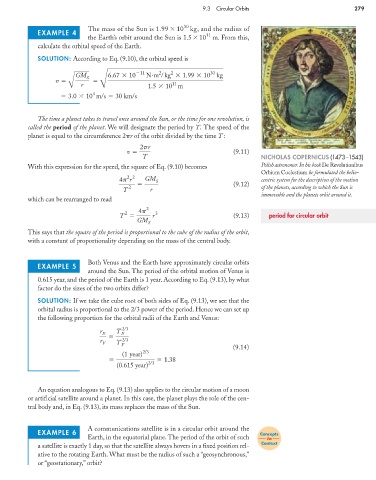
                                                        T                                   NICHOLAS COPERNICUS (1473–1543)
                     With this expression for the speed, the square of Eq. (9.10) becomes   Polish astronomer.In his book De Revolutionibus
                                                                                            Orbium Coelestium he formulated the helio-
                                                   2 2
                                                 4p r   GM  S                               centric system for the description of the motion
                                                   2                               (9.12)   of the planets, according to which the Sun is
                                                  T       r
                                                                                            immovable and the planets orbit around it.
                     which can be rearranged to read
                                                      4p 2  3
                                                  2
                                                 T          r                      (9.13)     period for circular orbit
                                                      GM
                                                         S
                     This says that the square of the period is proportional to the cube of the radius of the orbit,
                     with a constant of proportionality depending on the mass of the central body.


                                       Both Venus and the Earth have approximately circular orbits
                        EXAMPLE 5
                                       around the Sun. The period of the orbital motion of Venus is
                        0.615 year, and the period of the Earth is 1 year. According to Eq. (9.13), by what
                        factor do the sizes of the two orbits differ?
                        SOLUTION: If we take the cube root of both sides of Eq. (9.13), we see that the
                        orbital radius is proportional to the 2/3 power of the period. Hence we can set up
                        the following proportion for the orbital radii of the Earth and Venus:
                                                 2/3
                                           r E  T  E

                                           r     2/3
                                           V    T  V
                                                                                   (9.14)
                                                 (1 year) 2/3
                                                              1.38
                                                (0.615 year) 2/3


                        An equation analogous to Eq. (9.13) also applies to the circular motion of a moon
                     or artificial satellite around a planet. In this case, the planet plays the role of the cen-
                     tral body and, in Eq. (9.13), its mass replaces the mass of the Sun.


                                       A communications satellite is in a circular orbit around the
                        EXAMPLE 6                                                          Concepts
                                       Earth, in the equatorial plane. The period of the orbit of such  in
                                                                                            Context
                        a satellite is exactly 1 day, so that the satellite always hovers in a fixed position rel-
                        ative to the rotating Earth. What must be the radius of such a “geosynchronous,”
                        or “geostationary,” orbit?

