


Page 77 - Fisika Terapan for Engineers and Scientists
P. 77
9.2  The Measurement of G                          277


                     9.2 THE MEASUREMENT OF G


                     The gravitational constant G is rather difficult to measure with precision.The trouble
                     is that gravitational forces between masses of laboratory size are extremely small, and
                     thus a very delicate apparatus is needed to detect these forces. Measurements of G are
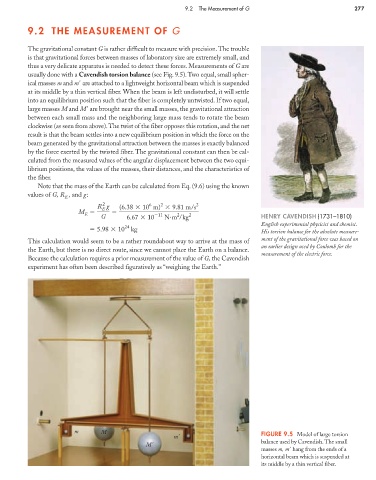
                     usually done with a Cavendish torsion balance (see Fig. 9.5).Two equal, small spher-
                     ical masses m and m  are attached to a lightweight horizontal beam which is suspended
                     at its middle by a thin vertical fiber. When the beam is left undisturbed, it will settle
                     into an equilibrium position such that the fiber is completely untwisted. If two equal,
                     large masses M and M  are brought near the small masses, the gravitational attraction
                     between each small mass and the neighboring large mass tends to rotate the beam
                     clockwise (as seen from above).The twist of the fiber opposes this rotation, and the net
                     result is that the beam settles into a new equilibrium position in which the force on the
                     beam generated by the gravitational attraction between the masses is exactly balanced
                     by the force exerted by the twisted fiber. The gravitational constant can then be cal-
                     culated from the measured values of the angular displacement between the two equi-
                     librium positions, the values of the masses, their distances, and the characteristics of
                     the fiber.
                        Note that the mass of the Earth can be calculated from Eq. (9.6) using the known
                     values of G, R , and g:
                                E
                                           2              6  2          2
                                          R g    (6.38   10  m)   9.81 m/s
                                      M    E
                                      E                     11    2   2
                                           G       6.67   10   N m /kg                      HENRY CAVENDISH (1731–1810)
                                                                                            English experimental physicist and chemist.
                                                  24
                                          5.98   10  kg                                     His torsion balance for the absolute measure-
                     This calculation would seem to be a rather roundabout way to arrive at the mass of  ment of the gravitational force was based on
                                                                                            an earlier design used by Coulomb for the
                     the Earth, but there is no direct route, since we cannot place the Earth on a balance.
                                                                                            measurement of the electric force.
                     Because the calculation requires a prior measurement of the value of G, the Cavendish
                     experiment has often been described figuratively as “weighing the Earth.”


                                   m       M                                                FIGURE 9.5 Model of large torsion
                                                                 m'
                                                                                            balance used by Cavendish.The small
                                                         M'
                                                                                            masses m, m  hang from the ends of a
                                                                                            horizontal beam which is suspended at
                                                                                            its middle by a thin vertical fiber.

