


Page 75 - Fisika Terapan for Engineers and Scientists
P. 75
9.1  Newton’s Law of Universal Gravitation                    275


                     For example, we can calculate the acceleration of free fall on the surface of the Moon
                     from its mass and radius.


                                       The mass of the Moon is 7.35   10 22  kg, and its radius is
                        EXAMPLE 2              6
                                       1.74   10 m.Calculate the acceleration of free fall on the Moon
                        and compare with acceleration of free fall on the Earth.
                        SOLUTION: For the Moon, the formula analogous to Eq. (9.6) is
                                                                              22
                                                                  2
                                     GM  Moon  6.67   10  11 N m / kg   7.35   10 kg
                                                               2
                              g
                               Moon     2                          6  2
                                      R                   (1.74   10 m)
                                        Moon
                                     1.62 m /s 2
                        This is about 1/6 the acceleration of free fall on the surface of the Earth ( g
                               2
                        9.81 m/s ). If you can jump upward to a height of one-half meter on the Earth, then
                        this same jump will take you to a height of 3 meters on the Moon!

                                                                                    30
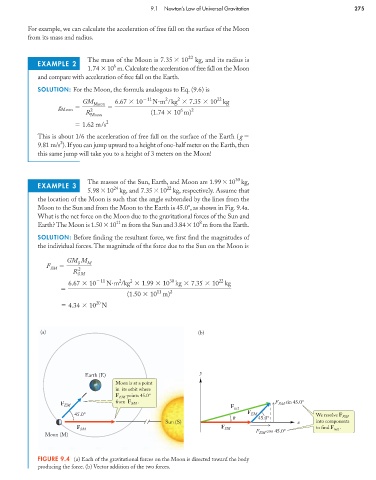
                                       The masses of the Sun, Earth, and Moon are 1.99   10 kg,
                        EXAMPLE 3              24              22
                                       5.98   10 kg, and 7.35   10 kg, respectively. Assume that
                        the location of the Moon is such that the angle subtended by the lines from the
                        Moon to the Sun and from the Moon to the Earth is 45.0 , as shown in Fig. 9.4a.
                        What is the net force on the Moon due to the gravitational forces of the Sun and
                                                                         8
                                                11
                        Earth? The Moon is 1.50 10 m from the Sun and 3.84 10 m from the Earth.
                        SOLUTION: Before finding the resultant force, we first find the magnitudes of
                        the individual forces. The magnitude of the force due to the Sun on the Moon is
                                 GM M  M
                                    S
                          F SM      2
                                   R
                                    SM
                                           11   2   2           30             22
                                 6.67   10   N m /kg   1.99   10 kg   7.35   10 kg

                                                            11
                                                   (1.50   10 m) 2
                                         20
                                 4.34   10 N

                         (a)                                             (b)


                                                                         y
                                      Earth (E)
                                               Moon is at a point
                                               in  its orbit where
                                               F EM  points 45.0°
                               F EM            from  F SM  .                      F net         F EM  sin 45.0°
                                   45.0°                                               F EM                 We resolve F
                                                                                   u       45.0 0°                  EM
                                                               Sun (S)                                 x    into components
                                    F SM                                       F SM       F  cos 45.0°      to find F net  .
                          Moon (M)                                                         EM


                        FIGURE 9.4 (a) Each of the gravitational forces on the Moon is directed toward the body
                        producing the force. (b) Vector addition of the two forces.

