


Page 13 - Fisika Terapan for Engineers and Scientists
P. 13
7.2  Work for a Variable Force                        213


                        To evaluate this integral, we rely on a result from calculus (see the Math Help box  This area is reckoned as
                        on integrals) which states that the integral between a and b of the function x is the  negative, since a negative
                                                    2
                                                  1
                                                                                                        x
                        difference between the values of  x at x   b and x   a:                    F x  F  does negative work
                                                  2                                                    during motion from a to b.
                                             b x dx    1 2  b  1 2  (b   a )
                                                            2
                                                                 2
                                                    x `
                                                   2
                                            a         a                                                   a       b     x
                                                                                                 O
                        where the vertical line ƒ means that we evaluate the preceding function at the
                        upper limit and then subtract its value at the lower limit. Since the constant  k
                                                                                                          Q
                        is just a multiplicative factor, we may pull it outside the integral and obtain for
                        the work
                                                                                                                  P
                                                                1   2   2
                                                        b
                                         b
                                   W      ( kx) dx   k   x dx    k (b   a )        (7.17)
                                                                2
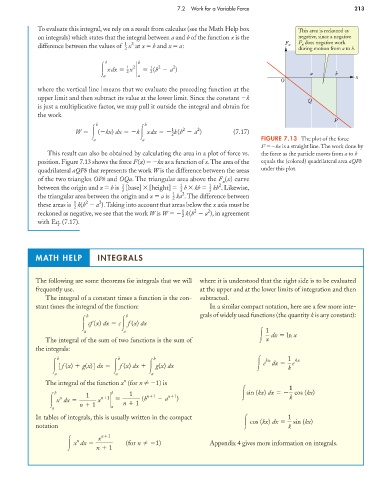
                                         a              a                                   FIGURE 7.13 The plot of the force
                                                                                            F   kx is a straight line. The work done by
                           This result can also be obtained by calculating the area in a plot of force vs.  the force as the particle moves from a to b
                        position. Figure 7.13 shows the force F(x)  kx as a function of x.The area of the  equals the (colored) quadrilateral area aQPb
                        quadrilateral aQPb that represents the work W is the difference between the areas  under this plot.
                        of the two triangles OPb and OQa. The triangular area above the F (x) curve
                                                                                x
                                                                               2
                                                                   1
                                                 1
                                                                            1
                        between the origin and x   b is [base]   [height]    b   kb   kb . Likewise,
                                                                            2
                                                                   2
                                                 2
                                                                    2
                                                                 1
                        the triangular area between the origin and x   a is  ka . The difference between
                                                                 2
                                          2
                                      2
                                   1
                        these areas is  k(b   a ).Taking into account that areas below the x axis must be
                                   2
                                                                       2
                                                                           2
                                                                    1
                        reckoned as negative, we see that the work W is W    k(b   a ), in agreement
                                                                    2
                        with Eq. (7.17).
                       MATH HELP          INTEGRALS
                       The following are some theorems for integrals that we will  where it is understood that the right side is to be evaluated
                       frequently use.                                   at the upper and at the lower limits of integration and then
                          The integral of a constant times a function is the con-  subtracted.
                       stant times the integral of the function:            In a similar compact notation, here are a few more inte-
                                        b cf (x) dx   c    b f (x) dx    grals of widely used functions (the quantity k is any constant):
                                      a           a                                           1
                                                                                             x
                          The integral of the sum of two functions is the sum of               dx   ln x
                       the integrals:
                              b 3  f (x)   g(x)4 dx      b f (x) dx      b g(x) dx           e  dx    1 k x
                                                                                             k x
                                                                                                      e
                                                                                                    k
                             a                 a          a
                                                  n
                          The integral of the function x (for n Z  1) is                            1
                                                    1
                              b x  dx    1   x n 1 ` b     n   1  (b n 1    a n 1 )    sin (kx) dx     cos (kx)
                                                                                                    k
                              n
                            a       n   1     a
                                                                                                    1
                       In tables of integrals, this is usually written in the compact     cos (kx) dx    sin (kx)
                       notation                                                                     k
                                    x dx    x n 1       (for n
 1)         Appendix 4 gives more information on integrals.
                                    n
                                          n   1

