


Page 87 - Fisika Terapan for Engineers and Scientists
P. 87
9.4  Elliptical Orbits; Kepler’s Laws                   287


                     of several tons are not unusual. All of the early artificial satellites burned up in the  Path of missile is a
                     atmosphere after a few months or a few years because they were not sufficiently far  portion of an ellipse.
                     from the Earth to avoid the effects of residual atmospheric friction.
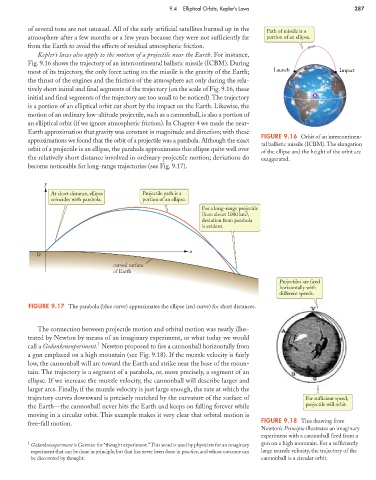
                        Kepler’s laws also apply to the motion of a projectile near the Earth. For instance,
                     Fig. 9.16 shows the trajectory of an intercontinental ballistic missile (ICBM). During
                     most of its trajectory, the only force acting on the missile is the gravity of the Earth;  Launch  Impact
                     the thrust of the engines and the friction of the atmosphere act only during the rela-
                     tively short initial and final segments of the trajectory (on the scale of Fig. 9.16, these
                     initial and final segments of the trajectory are too small to be noticed).The trajectory
                     is a portion of an elliptical orbit cut short by the impact on the Earth. Likewise, the
                     motion of an ordinary low-altitude projectile, such as a cannonball, is also a portion of
                     an elliptical orbit (if we ignore atmospheric friction). In Chapter 4 we made the near-
                     Earth approximation that gravity was constant in magnitude and direction; with these
                                                                                            FIGURE 9.16 Orbit of an intercontinen-
                     approximations we found that the orbit of a projectile was a parabola. Although the exact
                                                                                            tal ballistic missile (ICBM). The elongation
                     orbit of a projectile is an ellipse, the parabola approximates this ellipse quite well over
                                                                                            of the ellipse and the height of the orbit are
                     the relatively short distance involved in ordinary projectile motion; deviations do  exaggerated.
                     become noticeable for long-range trajectories (see Fig. 9.17).

                          y
                            At short distance, ellipse  Projectile path is a
                            coincides with parabola.    portion of an ellipse.
                                                                          For a long-range projectile
                                                                          (here about 1000 km),
                                                                          deviation from parabola
                                                                          is evident.


                                                                      x
                       O
                                               curved surface
                                               of Earth
                                                                                                 Projectiles are fired
                                                                                                 horizontally with
                                                                                                 different speeds.
                     FIGURE 9.17 The parabola (blue curve) approximates the ellipse (red curve) for short distances.


                        The connection between projectile motion and orbital motion was neatly illus-
                     trated by Newton by means of an imaginary experiment, or what today we would
                                          1
                     call a Gedankenexperiment. Newton proposed to fire a cannonball horizontally from
                     a gun emplaced on a high mountain (see Fig. 9.18). If the muzzle velocity is fairly
                     low, the cannonball will arc toward the Earth and strike near the base of the moun-
                     tain. The trajectory is a segment of a parabola, or, more precisely, a segment of an
                     ellipse. If we increase the muzzle velocity, the cannonball will describe larger and
                     larger arcs. Finally, if the muzzle velocity is just large enough, the rate at which the
                     trajectory curves downward is precisely matched by the curvature of the surface of  For sufficient speed,
                     the Earth—the cannonball never hits the Earth and keeps on falling forever while    projectile will orbit.
                     moving in a circular orbit. This example makes it very clear that orbital motion is
                     free-fall motion.                                                      FIGURE 9.18 This drawing from
                                                                                            Newton’s Principia illustrates an imaginary
                                                                                            experiment with a cannonball fired from a
                     1                                                                      gun on a high mountain. For a sufficiently
                      Gedankenexperiment is German for “thought experiment.”This word is used by physicists for an imaginary
                      experiment that can be done in principle, but that has never been done in practice, and whose outcome can  large muzzle velocity, the trajectory of the
                      be discovered by thought.                                             cannonball is a circular orbit.

