


Page 89 - Fisika Terapan for Engineers and Scientists
P. 89
9.5  Energy in Orbital Motion                        289


                     We already have evaluated this kind of integral in Example 2 of Chapter 8 (in the case
                     of the gravitational force, the constant A in that example is A    GMm). The result
                     of the integration is
                                             GMm   r 2  GMm    GMm
                                         W         `                               (9.19)
                                               x         r       r
                                                   r 1    2       1
                     As expected, this result shows that the work is the difference between two potential ener-
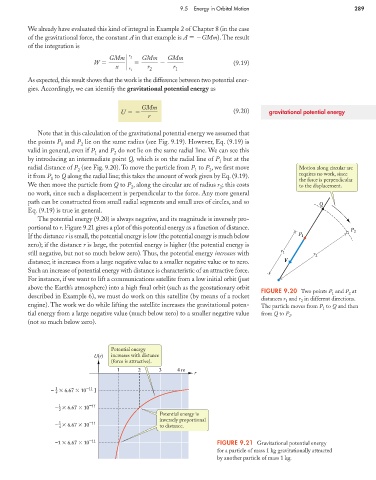
                     gies. Accordingly, we can identify the gravitational potential energy as

                                                       GMm
                                                                                   (9.20)     gravitational potential energy
                                                 U
                                                         r
                        Note that in this calculation of the gravitational potential energy we assumed that
                     the points P and P lie on the same radius (see Fig. 9.19). However, Eq. (9.19) is
                               1     2
                     valid in general, even if P and P do not lie on the same radial line. We can see this
                                         1     2
                     by introducing an intermediate point Q, which is on the radial line of P but at the
                                                                               1
                     radial distance of P (see Fig. 9.20).To move the particle from P to P , we first move  Motion along circular arc
                                    2                                  1    2
                     it from P to Q along the radial line; this takes the amount of work given by Eq. (9.19).  requires no work, since
                            1                                                                          the force is perpendicular
                     We then move the particle from Q to P , along the circular arc of radius r ; this costs  to the displacement.
                                                    2                          2
                     no work, since such a displacement is perpendicular to the force. Any more general
                     path can be constructed from small radial segments and small arcs of circles, and so    Q
                     Eq. (9.19) is true in general.
                        The potential energy (9.20) is always negative, and its magnitude is inversely pro-
                     portional to r. Figure 9.21 gives a plot of this potential energy as a function of distance.
                                                                                                                       P 2
                     If the distance r is small, the potential energy is low (the potential energy is much below  P 1
                     zero); if the distance r is large, the potential energy is higher (the potential energy is
                     still negative, but not so much below zero). Thus, the potential energy increases with  r 1  r 2
                     distance; it increases from a large negative value to a smaller negative value or to zero.  F
                     Such an increase of potential energy with distance is characteristic of an attractive force.
                     For instance, if we want to lift a communications satellite from a low initial orbit (just
                     above the Earth’s atmosphere) into a high final orbit (such as the geostationary orbit
                                                                                            FIGURE 9.20 Two points P and P at
                                                                                                                 1
                                                                                                                      2
                     described in Example 6), we must do work on this satellite (by means of a rocket
                                                                                            distances r and r in different directions.
                                                                                                        2
                                                                                                   1
                     engine). The work we do while lifting the satellite increases the gravitational poten-  The particle moves from P to Q and then
                                                                                                              1
                     tial energy from a large negative value (much below zero) to a smaller negative value  from Q to P .
                                                                                                    2
                     (not so much below zero).
                                              Potential energy
                                         U(r)  increases with distance
                                              (force is attractive).
                                                1     2      3    4  m
                                                                       r

                             1
                            –      6.67   10 –11
                             4
                                   1
                             –   6.67   10 –11
                              2
                                                             Potential energy is
                                                             inversely proportional
                                   3
                             –   6.67   10 –11               to distance.
                              4
                             –1   6.67   10 –11                               FIGURE 9.21 Gravitational potential energy
                                                                              for a particle of mass 1 kg gravitationally attracted
                                                                              by another particle of mass 1 kg.

