


Page 88 - Fisika Terapan for Engineers and Scientists
P. 88
288                                CHAPTER 9  Gravitation


                                                      Finally, we note that in our mathematical description of planetary motion we have
                                                   neglected the gravitational forces that the planets exert on one another. These forces
                                                   are much smaller than the force exerted by the Sun, but in a precise calculation the
                                                   vector sum of all the forces must be taken into account.The net force on any planet then
                                                   depends on the positions of all the other planets. This means that the motions of all
                                                   the planets are coupled together, and the calculation of the motion of one planet requires
                                                   the simultaneous calculation of the motions of all the other planets.This makes the pre-
                                                   cise mathematical treatment of planetary motion extremely complicated. Kepler’s
                                                   simple laws neglect the complications introduced by the interplanetary forces; these laws
                                                   therefore do not provide an exact description of planetary motions, but only a very
                                                   good first approximation.

                                                    ✔      Checkup 9.4


                                                   QUESTION 1: Suppose that the gravitational force were an inverse-cube force, instead
                                                   of an inverse-square force. Would Kepler’s Second Law remain valid? Would Kepler’s
                                                   Third Law remain valid?
                                                   QUESTION 2: A comet has an aphelion distance twice as large as its perihelion dis-
                                                   tance. If the speed of the comet is 40 km/s at perihelion, what is its speed at aphelion?
                                                   QUESTION 3: A comet has an elliptical orbit of semimajor axis equal to the Earth–Sun
                                                   distance. What is the period of such a comet?
                                                   QUESTION 4: If you want to place an artificial satellite in an elliptical orbit of period
                                                   8 years around the Sun, what must be the semimajor axis of this ellipse? (Answer in units
                                                   of the Earth–Sun distance.)

                                                      (A) 64       (B) 1622         (C) 8        (D) 4       (E) 2


                                                   9.5 ENERGY IN ORBITAL MOTION

                                                   The gravitational force is a conservative force; that is, the work done by this force on
                                                   a particle moving from some point P to some other point P can be expressed as a
                                                                                 1                  2
                                                   difference between two potential energies, and the work done on any round trip start-
                                                   ing and ending at some given point is zero.To construct the potential energy, we pro-
                                     P
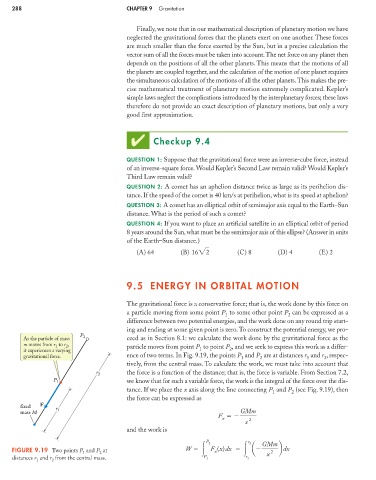
                   As the particle of mass  2      ceed as in Section 8.1: we calculate the work done by the gravitational force as the
                   m moves from r  to r , 2        particle moves from point P to point P , and we seek to express this work as a differ-
                             1
                   it experiences a varying                              1        2
                   gravitational force.            ence of two terms. In Fig. 9.19, the points P and P are at distances r and r , respec-
                                                                                           2
                                                                                                         1
                                                                                                               2
                                                                                     1
                                                   tively, from the central mass. To calculate the work, we must take into account that
                                          r 2      the force is a function of the distance; that is, the force is variable. From Section 7.2,
                             P 1                   we know that for such a variable force, the work is the integral of the force over the dis-
                                                   tance. If we place the x axis along the line connecting P and P (see Fig. 9.19), then
                                                                                               1     2
                                                   the force can be expressed as
                   fixed  F  r
                   mass M     1                                                      GMm
                                                                               F        2
                                                                                x
                                                                                       x
                                                   and the work is
                FIGURE 9.19 Two points P and P at                    W       P 2 F (x) dx       r 2  a   GMm  b dx
                                                                                              2
                                           2
                                     1
                                                                             x
                                                                                             x
                distances r and r from the central mass.                  P 1          r 1
                       1
                            2

