


Page 170 - NAVAL SCIENCE 3 TEXTBOOK
P. 170
176     NAVA L SKILLS


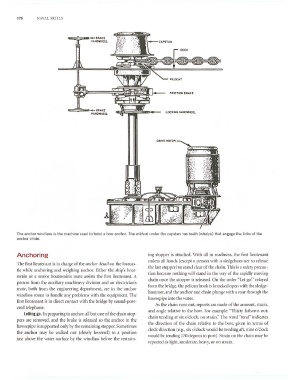
                                                                             DECK


                                                                        FRICTION  BRAKE


                              cr::==:;;: ... ~":" BRAK E
                                        HANO'lr1-lEEL                  LOCKINC HANO'lrtiEEL


         The anchor windlass is the machine used to hoist a bow anchor.  The wildcat under the capstan  has teeth  (whelps) that engage the links of the
         anchor chain.


         Anchoring                                             ing stopper  is  attached. \"ith all  in  reildiness,  the  first lieutenant
                                                               orders aU  hands  (except a person with a sledgehnlllmer to  release
         The first  lieutenant is in charge of the aI/chor detail on the forecas-
                                                               the last stopper) to stand clear of the chain. This is a safety precau-
         tle while  ~nchoring ~nd weighing anchor.  Either the ship's  boat-
                                                               tion because nothing will  st,lIld in  the way of the  rapidl)' moving
         swain  or a senior bo~tswain's mate  assists  the first  lieutenant.  A
                                                               chain once  the stopper is relcilsed. On  the order "Let  go!" relayed
         person from  the auxiliaq' machinery division and an electrician's
                                                               li'OI11 the bridge, the pelican hook is knocked open with the sledge-
         mate, both  from  the engineering department, ilre  in  the  anchor
                                                               hammer, and the ilncllor i.1nd chain plunge with a roar through the
         windlilss  room to  handle any problems with  the equipment. The
                                                               hawsepipe into the water.
         first lieutenant is in  direct contact with the bridge by sound-pow-
                                                                  As the chain runs out, reports arc mi.lde of the amount, strain,
         ered telephone.
                                                               and angle relati\'e to  the bow. For example: "Thirty tathoms out;
            letting go. In prcpnring to anchor, all but one of the chain stop-
                                                               chain  tending at six o'clock; no strain." The word "tend" indiC<ltcs
         pers are removed, nnd  the bfilke  is  released so  the ilnchor  ill  the
                                                               the direction of the chain  relative  to  the  bow, given in  terms  of
         hawsepipe is supported only by the remaining stopper. Sometimes
                                                               clock direction  (e.g., six o'clock would be tending aft, nine o'clock
         the  anchor  may  be  walked  out  (slowly  lowered)  to  n position
                                                               would be tending 270 degrees to port). Strain on the chain ma)' be
        just above  the willer surface  by  the  windlass before  the restrain-
                                                               reported as light, moderate, hem')', or no strain.

