


Page 171 - NAVAL SCIENCE 3 TEXTBOOK
P. 171
BASIC  SEAMANSHIP     177


                                                                  ,"Vith the chain veered to the proper scope, it should hang in a
                                                               slight catenary (dm\'l1\\'ard curve). Normally a stopper is attached,
                                                               and the ship will be slowly backed down to imbed (set) the anchor
                                                               into the sea !loor.1f too little chain is let out, the !lukes will not dig
                                                               well into the bottom, and the anchor is apt to drag. Loud rumbles
                                                               will be heard if the anchor drags on a rocky bottom, and a series of
                                                               vibrations rnay be felt on a rnud bottom.
                                                                  Weighing  anchor.  Before  the  anchor  is  hoisted  (weighed),
                                                               the windlass  engine is  tested.  The  wildcat  is  engaged,  the  brake
                                                               released, a strain is  taken  on the chain, and the stoppers are cast
                                                               loose.  Just before  the ship gets  under way,  the  anchor is  usually
                                                               heaved in to short stay. This is  a condition in which there is  the
                                                               minimum amount of chain out that keeps the anchor from break-
                                                               ing loose from the bottom; the chain is nearly vertical in the water.
                                                               Only the officer of the deck can order heaving to short stay,  and
                                                               then only after receiving permission from the captain.
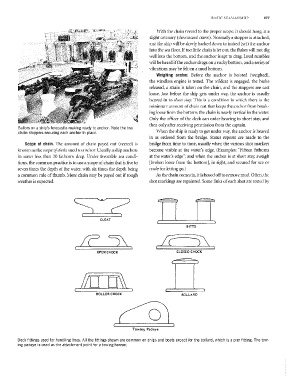
         Sailors on  a ship's forecastle making ready to anchor.  Note the two
                                                                  When the ship is  ready to get under way, the anchor is heaved
         chain  stoppers securing each anchor in  place.
                                                               in  as  ordered  from  the  bridge.  Status  reports  are  made  to  the
           Scope  of  chain.  The amount of chain  payed  out (veered)  is   bridge from time to time, usually when the various shot markers
        known as the scope of chain used to anchor. Usually a ship anchors   become visible  at the water's  edge.  (Examples:  "Fifteen fathoms
         in  water  less  than  20  fathoms  deep.  Under  favorable  sea  condi-  at the water's edge"; and when the anchor is at short stay, aweigh
         tions, the common practice is to use a scope of chain that is five to   [broken loose from  the bottom]' in sight, and secured for sea  or
        seven times the depth of the water, with St'{ times the depth being   ready lor letting go.)
        a common rule of thumb .. More chain may be payed out if rough   As the chain comes in, it is hosed off to remove mud. Often, the
        weather is expected.                                   shot markings are repainted. Some links of each shot are tested by


                                                                               sins

                                  !C  5\                            rc


                                          OPEN CHOCK                       CLOSED CHOCK


                                   do  D~


                                         ROLLER CHOCK                        BOLLARD


                                                        Towing  Padeye

        Deck fittings used for handling lines. All  the fittings shown are common on  ships and  boats except for the bollard, which  is a pier fitting. The tow-
        ing padeye  is  used as the attachment point for a towing hawser.

