


Page 173 - NAVAL SCIENCE 3 TEXTBOOK
P. 173
BA SIC.  $ EA;\IA NS HIP   179


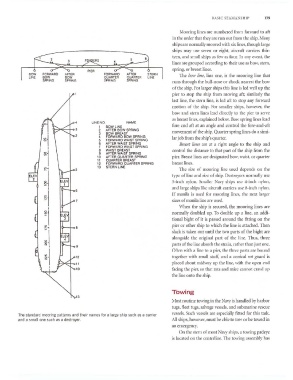
                                                                            Mooring lines are  llumbered from  forward  to  aft
                                                                         in the order that they are run out from  the ship. Many
                                                                         ships are normally moored with st.\:  lines, though large
                                                                         ships  Illay lise  seven  or eight,  aircraft  carriers  thir-
                                                                         teen, and small ships as  few as  foul'.  In  nny event, the
                       2                                5     6
                              3      FE   EAS    4
                                                                         lines nrc grouped according to their lise as bow, stern,
                                                                         spring, or breast lines.
                                      PlEA
             BOW   FORWARD   AFTER           FORWARD   AFTER   STERN
             LINE   BOW      BOW             QUARTER   QUARTER   LINE       The  bow line,  line  one,  is the  mooring line  that
                   SPRING    SPRING          SPRING   SPRING
                                                                         runs through the bull-nose or chock nearest the bow
                                                                         of the ship.  For larger ships this line is led ",ell up the
                                                                         pier  to  stop  the  ship  from  moving  aft;  similarly  the
                                                                         last line. the stern  line,  is  led  aft  to  stop any forward
                                                                         Illation  of the  ship.  For  smaller  ships,  howc\1er,  the
                                                                         bow and stern  lines  lead directly  to  the pier to  serve
                                                                         as breast lines, explained below. Bow spring lines lead
                                 4      LINE NO.      NAME
                                           1   BOW LINE                  fore and aft at an  angle and  control  the  fore-and-aft
                                 3         2   AFTER  BOW SPRING
                                           3   BOW BREAST                movement of the ship. Quarter spring lines do <1  simi-
                                 2         4   FORWARD BOW SPRING
                                           5   FORWARD WAIST  SPRING     1<11' job from  the ship's quarter.
                                           6   AFTER  WAIST  SPRING         Breast lilies  are  at  a  right  angle  to  the  ship  and
                                           7   FORWARD WAIST  SPRING
                                           8   WAIST  BREAST             control  the distance to  that pari  of the ship from  the
                                           9   AFTER  WAIST  SPRING
                                          10   AFTER OUARTER SPRING      pier. Bre<1sllines are design<1ted bow, waist, or quarter
                                          11   OUARTER  BREAST
                                          12   FORWARD  QUARTER SPRING   breast lines.
                                          13   STERN  LINE
                                                                            The  size  of mooring  line  used  depends  on  the
                                                                         type of line and size of ship. Destroyers 11000m<1l1), use
                                                                         5-inch  11),1011.  Smaller  N<lV}' ships  use  4-il1ch  nylon,
                                                                         and large ships like aircraft carriers LIse 8-inch  nylon.
                                                                         If manil<1  is  L1sed  for  mooring  lines, the next  l<lrger
                                                                         sizes of maniJa line are used.
                                                                            \·Vhen  the  ship  is secmed,  the  mooring lines are
                                                                         norma II)'  doubled  up.  To  double up a line, an  addi-
                                                                         tional  bight of it is passed  around  the  fitting on the
                                                                         pier or other ship to which the line is attached. Then
                          1Q--+-o8
                                                                         slack is taken out ulltil the  two parts of the bight arc
                                                                         alongside  the  original  part  of the  line.  Thus,  three
                                                                         parts of the line absorb the str<1in, rather than just one.
                                 9
                                                                         Often with a line to  i.1  pier, the three p<1rts arc bound
                                 12                                      together  with  smaU  stuff, and  <1  conical rat gilaI'd  is
                         /H";'-+-o11                                     phlCcd  about midway lip  the line, with  the open end
                                 10                                      facing the pier, so that ntts and mice cannot crawl up
                                                                         the line onto the ship.


                                                                         Towing
                                 13
                                                                         Iv10st routine towing in the Navy is handled by harbor
                                                                         tugs, fleet tugs, salvage vessels. and submarine rescue
                                                                         vessels. Such  vessels  are especiaU}'  fitted  for  this  task.
         The standard  mooring patterns and their names for a large ship such  as a carrier
         and  a small  one such as a destroyer.                          All ships, however, must be able to tow or be towed in
                                                                         an emergency.
                                                                            On the stern of mosl  N<1v)' ships, a towing padeye
                                                                         is located on the centerline. The towing assembly h<ls

