


Page 191 - NAVAL SCIENCE 3 TEXTBOOK
P. 191
I\IARI N E NAVIGATION   197

         Fixes and Lines of Posit ion

         In  plotting a ship's  location  on a chart, a  fLX  is  an accurate posi-
         tion determined without reference to any previolls position, using
                                                                                                       I
         visual,  electronic, or  celestial  observations.  A  fix  position  is  the
                                                                         \                             I
         intersection of two or more lines of posit;oll (LOPs) obtained at the
                                                                         \                            I
         same time.
                                                                                                     I
                                                                          \  "  /d'!l
                                                    /'                         ..........  ---

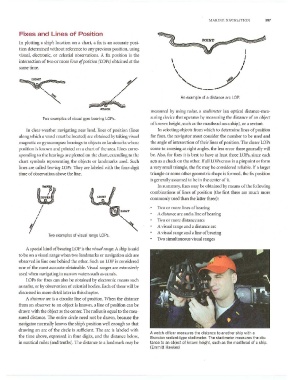
                                      ~                                     An  example of a distance arc  LOP.


                                           8TACK
                                                                measured  by  using  radar,  a stnriil1leter  (an  optical distance-mea-
                   Two examples of visual  gyro  bearing  LOPs.   suring device that operates by measuring the distance of an object
                                                                of known height. such as the masthead on a ship), or a se),."tant.
            Tn  clear-weather navigating near land, Jines  of position  (lines   In selecting objects from which to determine lines of position
         along which a vessel mllst be located) are obtained by talUng visual   for fixes,  the na\'igator must consider the number to be used and
         magnetic or gyrocompass bearings to objects or landmarks whose   the angle of intersection of their lines of position. The closer LOPs
         position is known and printed on a chart of the area. Lines corre-  come to crossing at right angles, the less error there generally will
         sponding to the bearings are plotted on the chart, extending to the   be.  Also,  for  fixes  it is best to  have at least  three LOPs, since each
         chart symbols  representing  the objects  or landmarks used.  Such   acts as a check on the other. If all LOPs cross in a pinpoint or form
         lines are called benrillg LOPs.  They are labeled with the four-digit   a very small triangle, the fix  may be considered reliable. If a larger
         time of observation above the line.                    triangle or some other geometric shape is formed, the fix position
                                                                is generall)' assumed to be in the center of it.
                                                                   In summar}', fixes  may be obtained by means of the following
                 b?I                                            combinations of lines of position  (the  first  three are  much  more
                                                                commonly used than the latter three):
                  ,
                 ,
                 ,  I                                              '1" '0 or more lines of bearing
                                                                   A distance arc and a line of bearing
                                                                   Two or more distance arcs
             "                                                     A visual range and a line of bearing
                                                                   A visual range and a distance arc
                     Two  examples of visual  range  LOPs.
                                                                   Two simultaneous visual ranges
            A special kind of bearing LOP is the viSltal ra1lge. A ship is said
         to be on a visual range when two landmarks or navigation aids are
         observed in line one behind the other. Such an LOP is  considered
         one of the most accurate obtainable. Visual ranges are extensively
         used when navigating in narrow waters such as canals.
            LOPs for  fixes  can also  be obtained by electronic means such
         as radar, or by observation of celestial bodies. Each of these will be
         discussed in more detail later in this chapter.
            A distcmce arc is a circular line of position. \"'hen the distance
         from  an observer to an object is  known, a line of position can be
         drawn with the object as the center. The radius is equal to the mea-
         sured  distance. The entire circle need  not be drawn, because  the
         navigator normally knows the ship's position well  enough so that
         drawing  an  arc of the  circle  is  sufficient.  The arc  is  labeled  with
                                                                A watch officer measures the distance to another ship with a
         the  time above. expressed  in  four  digits, and  the distance below,   Brandon  sextant-type stadimeter. The stadimeter measures the dis-
         in  nautical miles (and tenths). The distance to a landmark may be   tance to an object of known  height, such  as the masthead of a ship.
                                                                (Emmitt  Hawkes)

