


Page 189 - NAVAL SCIENCE 3 TEXTBOOK
P. 189
~!AR! N E NAV !GAT!O N   195


                        TRUE  NORTH                                To go from a relative to a true bearing, just add the ship's true
                                                                course to the  relative  bearing of the object sighted.  If the sum  is
                                                                less than 360°, that sum is the true bearing of the object. If the sum
                                                                is  more than 360°, subtract 360° from  the sum, and that difference
                                                                will be the true bearing of the object.


                                                                Nautical Charts
                                                                A /l(lIIticnl chart is a standardized drawing representing part of the
                                                                navigable waters of the Earth. A chart  has shading on it  to show
                                                                water  areas  and  nearby  land  outlines  to  help  a  ship's  navigator
                                                                find his or her wa}' at sea. Nautical charts give a great deal of infor-
                                                                mation  to  the  navigator.  This  is  called  hyrlrographic  ill/ormation.
                                       '0                       Charts display water features such as depth and overhead obstruc-
                                     LIGHTHOUSE
                                                                tions, and they have symbols  representing navigational  aids such
                                                                as buoys, lights, and anchorages.
         A comparison of true and  relative bearings,  showing the relationship   The globe is a spherical, three-dimCI1sional (length, width, and
         between them.
                                                                height) object, but it  is  not practical to work navigation problems
                                                                or chart courses on a  round  surface.  It is  necessaq',  therefore, to
            Bearings  are  given  in  three  digits, as  with  nautical  direction.   convert the round surface of the globe to one that is flat and two-
         \"'hen recording a bearing, it is assumed to be a true bearing unless   dimensional (having only length and width) - in short, a flat piece
         followed by the letters lvl  or R.  For example 030°1\,1 means 30° to   of paper on which a chart is drawn.
         the right of magnetic north, spoken "zero three zero degrees mag-  Cartographers  (map  and  chart  makers)  have  used  math  to
                     0
         netic:' while 030 R means 30° off the starboard bow. spoken "zero   work  out chart projection  techniques. These  techniques  make it
         three zero degrees relative," Objects seen by lookouts arc reported   possible to  create charts with a  minimum of distortion from  the
         in terms of relative bearing by degrees. Note the following relative   actual spherical globe.
                                                    o
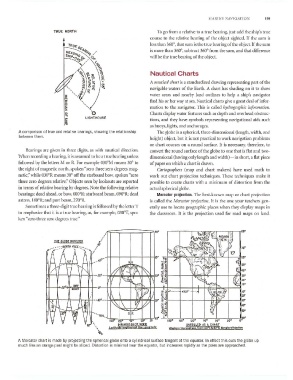
         bearings: dead ahead, or bow, OOooR; starboard beam, 090 R; dead   Mercator projection. The best-known map or chart projection
                 o
         astern, 180 R; and port beam, 2700R.                   is  called  the klermtor projectioll.  It is  the one your  teachers gen-
            Sometimes a three-digit true bearing is followed by the letter T   erally use  to  locate geographic places when  they display  maps  in
         to emphasize that it is a true bearing, as, for example, 030<>'[, spo-  the classroom.  It  is  the  projection  used  for  road  maps on  land.
         ken "zero three zero degrees true."


                                                                       .---.---.-~~~~--~~--,.~
                                                                                   '\)0  ~;r (;
                                                                                               J.~J.:.
                                                                                C ~..;~~.  \S.~~:~ff
                                                                       ftA:i.&~~'ro {l)~              ",
                        THE  GLOBE UNfOlO£O
                                                                  60'  ~~  "\ii~~~jrl>~
                                                       H P.
                                               I h  1Yi '.',:'.,.:;D.'  ~   ~~   \I,} , "\ '''''f
                                               v/  rj)  '"'l. )T\1  \'\   30°  ~:~   K6:.t   .'::'
                                                                    :"i3:t::
                                                                                  '~
                                               II  V'\1;K~          ~~~             I  ~h
                               IBOO
                    1+-4--JI)'  .",,,
                                      "        1\         fj~~  H'········  4501'·  .... ~  ~@,       :~
                    Wi.;:r-"-i<'---'''---iL-:r-,,,-Ji, '-I--.,'L+~:==l""-t-=;fia'l-~'-1'"  .§:~ f.--+---+----t--#...jll"bW=-+---~ lO"
                                                         fIl V
                                                                    ~i~
                       ~'
                                               I~l\
                                                                                                      ...
                                   }I
                      \l,'  y--_.1  ~ __ -1  \~         ·-h.z:'E;                                     !II'
                                                                     i~
                      V    SQ   M    9q'  ,-...... 60t  ... ,  ·'-;l'W"'--',"'"20",--;!;,,--.l60,,-lO lii"" 60°  ....L 1600   I~O.   120·   90.   bO°   30·   o~
                                                      S.  P.
                                                                               UNR.OLLED  AS  A CH"'RT   •.
                                         "                              WIlt.," HCmispMl'!j  (,om 60°5 lo80"tl MtrcatOl"lTojtdicrl
                                          q,.
         A Mercator chart is made by  projecting the spherical globe onto a cylindrical surface tangent at the equator.  In effect this cuts the globe  up
         much  like an  orange  peel  might be  sliced.  Distortion  is minimal  near the equator,  but increases rapidly as the poles are  approached.

