


Page 188 - NAVAL SCIENCE 3 TEXTBOOK
P. 188
194      NAVAL  SKILLS

        minutes gave an estimate of the ship's speed, from which the num-
        ber of nautical miles covered per hour could be figured.
           Nowadays ship speed through the water is determined by use
        of a speed log (like a speedometer), either mechanical or electronic.
        Mechanical speed logs have a small  propeller that extends down
        beneath a vessel's  hulL  The water streaming past  the hull rotates
        the propeller, and the vessel's speed is  proportional to the speed
        of rotation. Others have a pitot Wbe that measures the speed of the
        water stream by pressure  difterences. Electronic speed logs mea-
        sure vessel speed electronically by projecting sound beams down
        into the ,vater.
           Direction.  True llautical direction  is measured from  true north
        (north pole) as located on a globe. This used to be given in olden
        days  by poillts on the compass rose,  such  as  north, north by east,
        north-northeast, and so on.lvlodern navigators use a system of cir-
        cular measurement using 360 degrees of are, which is more accu-
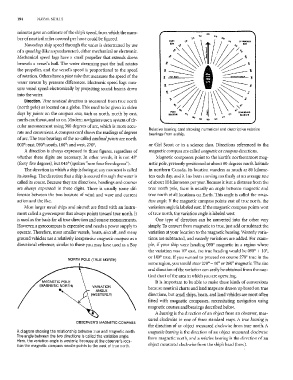
                                                               Relative bearing card showing numerical and descriptive relative
        rate and convenient. A compass card shO\vs the readings of degrees   bearings from a ship.
        of arc. The true bearings of the so-called cardinal points are north,
        000'; east, 090'; south, 180'; and west, 270'.         or Girl  Scout or in a  science  class.  Directions  referenced  to the
           A direction  is always  expressed in  three figures,  regardless of   magnetic compass are called magnetic or compass directions.
        whether  three  digits  are  necessary.  In  other words,  it  is  not 45°   Magnetic compasses point to the Earth's northernmost mag-
        (forty-five degrees), but 045' (spoken "zero four five degrees").   netic pole, presently positioned at about 80 degrees north latitude
           The direction in which a ship is facing at any moment is called   in northern Canada. Its location wanders as nmch as  80 kilome-
        its heading. The direction that a ship is steered through the water is   ters each day, and it has been moving northerly at an average rate
        called its course. Because they are directions, headings and courses   of about 10 kilometers per year. Because it is at a distance from the
        are  always  expressed  in  three  digits.  There  is  usually  some  dif-  true north pole, there is  usually an  angle between  magnetic and
        ference  between the two because of wind and wave and current   true north at all locations on Earth. This angle is called the varia-
        action and the like,                                   tion (mgle,  If the magnetic compass points east of true north, the
           ivIost larger naval ships and aircraft are fitted with an instru-  variation angle is labeled east. If the magnetic compass points west
        ment caned a gyrocompass that always points toward true north. It   of true north, the variation angle is labeled west.
        is used as the basis for all true direction and course measurements.   One type  of direction  can  be converted into  the  other very
        However, a gyrocompass is expensive and needs a power supply to   simply. To convert from magnetic to true, just add or subtract the
        operate. Therefore, most smaller vessels, boats, aircraft, and many   variation at your location to the magnetic bearing. 'Vesterly varia-
        ground vehicles use a relatively inexpensive magnetic compass as a   tions are subtracted, and easterly variations are added. For exam-
        directional reference, similar to those you may have used as a Boy   ple,  if your ship were heading 090°  magnetic in a  region  where
                                                               the variation was  10° east, the true heading would be 090° + 10°,
                                                               or 100° true. If you wanted to proceed on course 270° true in the
                             NORTH POLE (TRUE NORTH)
                                                               same region, you would steer 270° - 10° or 260° magnetic. The size
                                                               and direction of the variation can easily be obtained from the nau-
                                                               tical chart of the area in which you are operating.
                                                                  It is important to be able to make these kinds of conversions
                                                               because nautical charts and land maps are drawn up based on true
                                                               directions, but small ships, boats, and land vehicles are most often
                                                               fitted  with  magnetic  compasses,  necessitating  navigation  using
                                                               magnetic courses and bearings described below.
                                                                  A bearing is the direction of an object from an observer, mea-
                                                               sured clockwise  in  one of three standard ways. A true bearing is
                                 OBSERVER'S MAGNETIC COMPASS
                                                               the direction of an object measured clockwise from true north. A
        A diagram showing the relationship between true and  magnetic north.   magnetic bearing is the direction of an object measured clockwise
        The angle between the two directions is called the variation angle.   from  magnetic north, and a relative bearing is the direction of an
        Here, the variation angle  is westerly,  because at the observer's loca-
        tion the magnetic compass needle paints to the west of true  north,   object measured clockwise from the ship's head (bow).

