


Page 187 - NAVAL SCIENCE 3 TEXTBOOK
P. 187
l\IARINE NAV I GATION   193


         Meridians                                                 The starting point for  numbering the parallels  is  the equator.
                                                                the 0° parallel. Parallels are numbered from 0° at the equator to 90°
         There are an  infinite  number of meridians  running from  pole to
                                                                north  (N)  at the  north pole, and from  0'  to  90' south  (5)  at  the
         pole, but rarely are they drawn more often than one for each degree
                                                                south pole. A place in the Northern Hemisphere. for example, might
         around the Earth. On the average globe. map or chart, meridians
                                                                be located at 35°N, while one in the Southern Hemisphere might be
         are  usually  drawn  every  5  or  10  degrees.  ~'lore will  sometimes   0
                                                                at 50 S. In navigation. the parallels are called latitl/de lines.
         be  drawn  all  enlarged  navigation  charts.  The  starting  point  for
         numbering these  meridians  is  the  meridian  on  which  the  Royal
         Observatory  at  Greenwich,  England,  is  located.  The  Greenwich   Latitude and Longitude
         meridian, therefore, is  numbered 0,  or 0°, and is  called  the prime
                                                                \'Ve  have seen  that  there  is  a  network of meridians and  parallels
         11lcridialJ.
                                                                all  the wa),  around the globe. Thus, ever), spot on Earth  ma)' be
                                                                located at the intersection of a meridian and a parallel. The navi-
                                                                gator describes every location  on the Earth in  terms of its  corre-
                                                                sponding  latitude  and  longitude.  Latitude  is  the  distance  of arc
                                                                north  (N)  or south  (5)  of the equator.  It  is  expressed  in degrees,
                                                                minutes, and seconds, measured along the meridian of the place.
                                                                longitude is  the distance in  degrees. minutes, and seconds of arc
                                                                east  (E)  or west  (\V)  of the prime meridian. measured along the
                                                                parallel of latitude. Let's state it again: latitude is always measured
                                                                north or south from 0° through 90°, and longitude is always mea-
                                                                sured east or west from 0° through 180°.
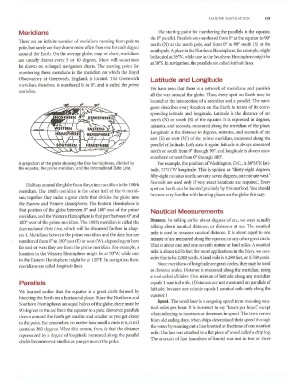
         A projection of the globe showing the four hemispheres, divided by   For example, the position of Washington, D.C., is 38'58'N lati-
         the equator,  the prime meridian, and the  International  Date  Line.   tude, 7rOJ'\V longitude. This is  spoken as "thirty-eight degrees,
                                                                fifty-eight minutes north; seventy-seven degrees, one minute west."
                                                                Seconds are  used  only if very exact locations are  required.  Eveq'
            Halfway around the globe from the prime meridian is the 180th
                                                                spot on Earth can be located precisel), b)' this method. You should
         meridian. The  180th  meridian  is  the  other  half of the  0  merid-
                                                                become vcr}' familiar with locating places on the globe this way.
         ian;  together  they make a  great  circle that divides  the  globe  into
         the  Emtem  and ''''estem  Hemispheres.  The Eastern  Hemisphere is
         that portion of the globe between 0°  and  180° east of the  prime
                                                                Nautical Measurements
         meridian, and the \-"estern Hemisphere is that part between 0° and
                                                                Distance.  In  talking earlier about degrees of arc, we  were actually
         180° west of the prime meridian. The 180th meridian is called the
                                                                talking  about  nautical  distance,  or distances  at  sea.  The  nautical
         illte/'IJatio/wl  Date LillC,  which  will  be discussed  further  in  chap-
                                                                mile is  used to  measure nautical distance.  It  is about equal to one
         ter 4. Meridians between the prime meridian and the date line are
                                                                minute of arc measured along the equator, or any other great circle.
         numbered from 0° to 180° east (E) or west (\V ). depending on how
                                                                That is about one and one-seventh statute or land miles. A nautical
         far east or west they are from  the prime meridian. For example, a
                                                                mile is about 6.076 feet;  for  most applications in the Navy, we con-
         location in  the \Vestern  Hemisphere might be at 700\V, while one
                                                                sider this to be 2,000 ),ards. A land mile is 5,280 feet, or 1,760 yards.
         in  the Eastern Hemisphere might be at 1200E. In  navigation these
                                                                   Since meridians oflongitude are great circles, they may be used
         meridians are called IOl/gitl/de lines.
                                                                as distance scales. Distance is  measured along the meridian, using
                                                                a tool called dividers.  One minute of latitude along an)' meridian
         Parallels                                              equals 1 nautical mile. (Distances are not measured on parallels of
                                                                latitude, because one minute equals 1 nautical mile only along the
         \'Vc  learned  earlier  that  the  equator  is  a  great  circle  formed  b)'
                                                                equator.)
         bisecting the Earth on a horizontal plane. Since the Northern and
                                                                   Speed. The word kllot is a seagoing speed term meaning nau-
         Southern Hemispheres are equal hi.llves of the globe, there must be
                                                                tical  miles per hour. It is  incorrect to say "knots per hour," except
         90 degrees in the arc from the equator to a pole. However, parallels
                                                                when referring to increases or decreases in speed. The term comes
         drawn around the Earth get smaller and smaUer as  you get closer
                                                                from old sailing days. when ships deterrnined their speed through
         to the poles. 13lH remember, no matter how small a circle it is, it still
                                                                the water by funning out a line knotted at fractions of one nautical
         contains 360 degrees. \Vhat this  means, then, is  that  the distance
                                                                mile. The line was attached to a flat piece of wood called a chip log.
         represented  by a degree of longitude  measured along the parallel
                                                                The amount of line  (numbers of knots)  run out in  two or three
         circles becomes ever smaller as you get nearer the poles.

