


Page 192 - NAVAL SCIENCE 3 TEXTBOOK
P. 192
198     NAVA L  SKI LLS


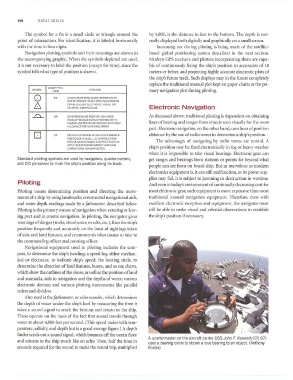
            The s)'mbol  for a  fix is a small  circle or triangle around  the   by 4,800, is the distance  in  feet to  the bottom. The depth is  nor-
         point of intersection.  For  identification, it  is labeled  horizontally   mally displayed both digitally and graphically on a small screCll.
         with the time in four digits.                             Increasing use  during piloting is being made of the satellile-
            Navigation plotting symbols and their meanings are shown in   b<lsed  global  positioning  system  described  ill  the  Ilext  section.
         the accompanying graphic. When the symbols depicted are  used,   Modern GPS recei\'ers <lnd plotters incorpor;.lting them are capa-
         it is not necessary to label  the position (except for time), since the   ble of continuously fixing the ship's  position  to '1Ccuracies  of 10
         symbol tells what type of position is shown.           meters or better, and projecting highly accurate ekctronic plots of
                                                                the ship's future tJ'ilck. Such displays  may in the future completely
                                                                replace the traditional manual plot kept on paper charts as the pri-
                     DESCRIPTIVE
               SYI.IBOL                MEANING                  mary navigation plot during piloting.
                       LABEL
               0        '"   AN ACCURAl E POSITION DETER'.'IIIED WITH·
                             OUT REFERENCE TOANY PREVIOUS POSlTIo.'I
               6.            CELESTIAL OBSERv~no:~s             Electronic Navigation
                             ESTABUSHEOBY flEC1Ro,·'IIC. VISUAL  OR
               ~  DR         OEAORECKm.M~Gf'OSITiON AO':~t.'CEO   As discllssed abO\'e, tradition<ll piJoting is dependent on obtaining
                             FAOI.IA PREVlQUS Kt~OMj f'OSITIO."1 OR FIX
                             COURSE ANDSPEEDAAE AECKO:,EOWITHOUT   lines of bearillg and ranges from objects seen visually for the most
                             ALLO ... ·,),NCE FORWl:-':O OR CURRENT
                                                                part. Electronic lI(llligntiOl/, on the other hand, uses lines of position
               0        "    Esm.!ATED POSlTIQr-j  IS THE MOST PROOABLE   obtained b)' the use of mdio waves to determine a ship's position.
                             POSHlO~j OF A VESSEL. OETER'.'INED FAO.'.I
                             DATA OF OUEsn Q.'lABLE ACCUR~Y. SUCII AS   The  advantages  of navigating by  radio  waves  are  several.  A
                             APPLYING Esm.'AlED CURAEIIT AND I'.IND
                             CORRECTlONS TO A OR POSt TlQ:oI   ship's position may be fixed electronically in fog or heavy weather
                                                               when  it is  impossible to take  visual bearings.  Electronic gear can
         Standard  plotting symbols are used  by navigators, quartermasters,   get ranges  and bearings  from stations or points fur beyond  what
        and CIC personnel to mark  the ship's position along its track.
                                                               people can see from  on board  ship. Uut  as  marvelous as modern
                                                               electronics equipment is, it can still  malfunction, or its power sup-
                                                               plies  may fail. It is subject to jamming or destruction in  wartime.
         Piloting                                              And even in today's environment of continually decreasing cost for

         Piloting  means  determining  position  and  directing  the  move-  most electronic gear, sllch equipment is more expensive than Illost
         ments of a ship by using landmarks, constructed navigational aids,   traditional  Illanual  navigation  equipment.  Therefore,  even  " 'ith
         and  water depth  readings  made by a !athometer, described below.   excellent electronic reception and equipment, the navigator must
         Piloting is the primary means of navigation when entering or leav-  still  be able to  make visual and celestial  observations to  establish
         ing port and in coastal navigation. In piloting, the navigator gives   the ship's position if necessary.
         warnings of danger (rocks, shoal water, wrecks, etc.), fixes the ship's
         position frequentl), and accuratel), on the basis of sightings  taken
         of aids and land features, and recommends what course to take to
         the commanding officer and conning officer.
            Navigational equipment  used  in  piloting  includes  the  com~
         pass, to determine the ship's heading; a speed log, either mechan-
         ical or  electronic,  to  indicate ship's  speed; the  bearing  circle, to
         determine the di rection ofland features, buoys, and so on; charts,
         which show the outlines of the shore, as well as the position of land
         and seamarks, aids to navigation and the depths of W<lter; various
         electronic  devices;  and  various  plotting  instruments  like parallel
         rulers and dividers.
            Also used is the !atllOmeter, or echo sOIlIIrier, which determines
         the depth of water under the ship's  keel by measuring the time it
         takes  a sOllnd signal  to  reach  the bottom and return  to the ship.
        These  operate on the basis of the fact that sound travels through
        water at about 4,800 feet per second. (This speed varies with tem-
        perature, salinity, and depth but is a good average figure.) A depth
         finder sends out a sound signal, which bounces otT the ocean noor
                                                               A quartermaster on  the aircraft carrier USS John F.  Kennedy (eV 67)
        and returns to the ship much like an echo. Then, half the time in
                                                               uses a bearing circle to obtain a true bearing to an object.  (Anthony
        seconds required for the sound to make the round trip, multiplied   Riddle)

