


Page 200 - NAVAL SCIENCE 3 TEXTBOOK
P. 200
206      NAVA L SKILLS

        Buoy Numbering and  Lights
           Red buoys marking the right side of a channel bear even num-
        bers,  starting  with  the  first  buoy  from  seaward.  Green  channel
        buoys, to  the left of the channel coming from  seaward, have odd
        numbers.  Banded  or striped buoys are not l1umbered, but some
        have letters identifying the  name of the buoy,  such as  Governors
        Island West End Shoal Bell Buo)' (GI) and East Rockawa), Inlet Bell
        Buo)' (ER).
           Red  lights are  used  onl), on  red  channel  buo)'s.  Green  lights
        are onl), for green channel buo)'s. White lighls are  Ihe onl), lighls
        lIsed on  preferred-channel (junction) or safe-water  (mid-chan-
        nel)  buo)'s.
           Characteristics of lights on lighted buo),s are as follows:
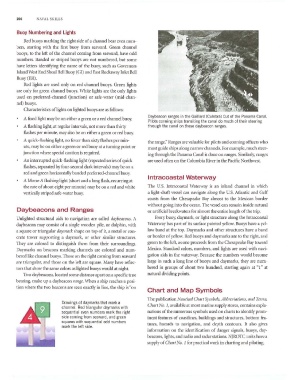
                                                               Daybeacon  ranges in the Gaillard (Culebra) Cut of Ihe Panama Canal.
           A fixed light may be 011 either a green or a red channel buoy.
                                                               Pilots conning ships transiting the canal do much of their steering
           A flashing light. at regular intervals, not more than thirty   Ihrough the canal on  these daybeacon  ranges.
           flashes per minute, may also be on either a green or red buo),.
           A quick-flashing light, no fewer than sLxt)' flashes per min-
                                                               the range." Ranges are valuable for pilots and conning officers who
           ute, may be on either a green or red buoy at a turning point or
                                                               must guide ships along narrow channels. For example. much steer-
           junction where special caution is required.
                                                               ing through the Panama Canal is done on ranges. Similarly, ranges
           An inlerrupted quick-flashing light (repeated series of quick   are used often on the Columbia RiveT in the Pacific Northwest.
           flashes, separated by four-second dark intervals)  may be on a
           red and green horizontally banded preferred-channel buoy.
                                                               Intracoastal Waterway
           A Morse A flashing light (short and a long flash, recurring al
           the rate of about eight per minute) may be on a red and white   The  U.S.  Intracoastal  \,Vatcrway  is  an  inland  channel  in  which
           vertically striped safe-water buoy.                 a light-draft vessel  can navigate  along the  U.S.  Atlantic and Gulf
                                                               coasts  from  the  Chesapeake  Bay  almost  to  the  Mexican  border
                                                               without going into the ocean. The vessel can remain inside natural
        Daybeacons and Ranges                                  or artificial breakwaters for almost the entire length of the trip.

        Unlighted  structural  aids  to  navigation  are  called dllybeacolls.  A   Every buoy,  dayI1wrk, or light structure along the Intracoastal
        da}'be<lcon may consist of a single  wooden  pile, or dolphin, with   \,Vaterway has part of its surface painted yellow.  Buoys have a yel-
        a square or triangular daYlI/ark shape on top of it, a metal or con-  low band at the top.  Daymarks and other structures  have a band
        crete  tower  supporting  a  daymark, or  other  similar  structures.   or border of ),ellow.  Red buo)'s and dal'l11arks arc 10  the right, and
        They  are  colored  to  distinguish  them  from  their  surroundings.   green to the left, as one proceeds from the Chesapeake Bay toward
        Daymarks  on  beacons  mnrking channels are  colored and  num-  Mexico. Standard colors, numbers, and lights are used with  navi-
        bered like channel buoys. Those on the right coming from seaward   gation aids  in  the waterway.  Because the  numbers would become
        nrc triangular, and those on the left are square. ;vlallY have reflec-  large in  such  a long line of buoys and  daymarks,  the)r are  num-
        tors that show the same colors as lighted buoys would at night.   bered  in  groups  of about  two  hundred, starting again  at  "1"  at
           '1\\'0 daybeacons.located some distance apart on a specific true   natural dividing points.
        bearing, make up a daybeacon  mllge. \Vhen a ship reaches a posi-
        tion where the two beacons are seen exactly in line. the ship is "on
                                                               Chart and Map Symbols

                                                               The publication Nautiml Chart SYIIlbols, Abbreviatiolls, alld 1erllls,
                           Drawings of daymarks that  mark a
                           channel.  Red  triangular day marks with   Chart No.1, available at most marine supply stores. contains expla-
                           sequential even  numbers mark the right   nations of the Ilumerous s}'l1lbols used on charts to identif)' prom-
                           side coming from seaward,  and green   inent features of coastlines. buildings and structures, bottom  fea-
                           squares with sequential odd  numbers   tures, hazards  to  navigation. and  depth  contours.  It  also  gh'es
                           mark the lett side.
                                                               information  on the  identification  of danger signals,  buo}'s,  day-
                                                               beacons, lights, and radio and radar stations. NjROTC units have a
                                                               supply of Cllart No.1 for practical work in charting and piloting.

