


Page 197 - NAVAL SCIENCE 3 TEXTBOOK
P. 197
Aids to  Navigation


          Piloting is olle branch of marine navigation, In traditiollal piloting,   the duration of darkness. There are variations of these called fixed
          a ship's position is mostly determined by bearings taken 011 visible   flIld j1ashillg, with the fixed light intensifying at intervals with two
          objects whose exact locations are shown Oil a chnrt. Some of these   or more bright flashes; and grollp j1ashillg,  in  which  two or more
          objects may be naturallnndmarks, such as  hills,  rocks, islands, or   groups of flashes are shown at regular intervals.
          cliffs. Others may be large buildings. smokestacks, television tow-  Ocwltillg lights are totally off at regular intervals, the duration
          ers, church steeples,  ilnd  so  011,  which  arc  located  close  to shore   of light always being greater than the duration of darkness. Group
          ",here they can be casil}' spotted by navigators.      occultillg lights have two or 1110re oft· periods ilt regular intervals.
             ~'Iost aids  to  navigation, though, are specially constructed  to   Variations of these principal light characteristics include eqlfnl
          assist  in  the safe navigation of vessels. These  include lighthouses,   illfen'nl,  in  which  the duration  of light  equals  that  of darkness;
          light towers, navigation  lights, buoys, and da}'beacolls. Most har-  lV/orse code, where the light flashes represent a Morse code charac-
          bors and well-traveled  coasts  are  well  marked  with  these  aids  to   ter (usuaU)' the letter A); and nltemntillg, in which rhythmic lights
          navigation. Elsewhere, these kinds of aids mayor may not be pres-  show different colors during each sequence.
          ent to assist the navigator. \Vhen specially constructed aids are not
          <\\'ailable, or when the}' become inoperative or Ollt of position, then
          nnturallandmarks must be used.
             This chapter will discliss the major types ofconstrllcted naviga-
          tional aids found in international and inland waters. AJI who oper-
          ate watercraft  in  rivers, lakes,  harbors,  the  Intracoastal  \Vaterway,
          and along seacoasts IllllSt know about these navigation  aids, just
          ilS one who drives a car or truck on the nation's highways must be
          able to interpret road signs.


          Lights
          Vessels under way operate at night as well as by day. Therefore, nav-
          igation lights are important aids to  night navigation. These lights
          are identified primarily by their color, pattern of flashes, and tim-
          ing interval (period). Of these, the timing interval is considered the
          1110st valuable for  identification  purposes, since that  is least likely
          to  be confused  if scveralnavigationallights are  present in  a given
          area. These identifying attributes, together with height and nomi-
          Ilal visibility, are uSllall}' printed in abbreviated fornl  Ilear the light
          symbol on the nautical chart. Other details are set forth in publica-
          tions called light lists that are a\'ailable for purchase in 1110st nauti-
          cal suppl)' stores.

          Light Characteristics
             There  are  three  principal  general  patterns  of flashes,  called
          cltnmcteristics,  of navigational lights:  fi....:ed,  flashing,  and  occult-
          ing.  Fixed lights burn steadily.  Flashillg  lights show single flashes
          of light at  regular  intervals,  with  the  duration  of light  less  than
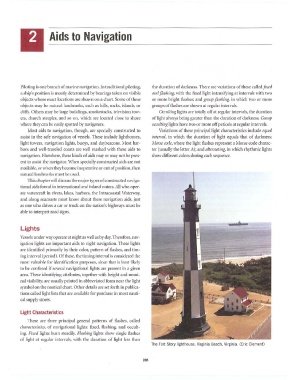
                                                                The Fort Story lighthouse, Virginia Beach, Virginia.  (Eric Clement)


                                                             203

