


Page 199 - NAVAL SCIENCE 3 TEXTBOOK
P. 199
~ I AR1 NE NAV I GAT IO N   205

          B uoys                                                    A lighted buoy carries batteries or gas tanks and has a frame-
                                                                    work that supports a light.
          Navigational buoys are moored, floating  markers placed to guide
                                                                    A fOlllbil/(ltioll bllo)' is one in which a light and sound signal
          ships and  boats  safely  along channels  and  in  and  out  of ports.
          Buoys on water are  like street signs  for motorists on  land.  They   are combined. such as a lighted bell. gong. or whistle buoy.
          also  warn  vessels  away  from  hidden  dangers  and  lead  them  to
          anchorage areas. They may be of various sizes and shapes, but it is   COloring of Buoys
          mainly their coloring that  indicates their purpose.  BUD}, symbols   As stated previously. in the inland waters of the United States,
          are printed on harbor charts. so buoys can be llsed for determining   red buoys mark the  right side of a channel,  and green buoys the
          positions in piloting,                                 left side, coming from seaward. Of great help in  remembering this
             A system of buoy  age called the IALA (International Association   placement  of buoys  is the jingle "red-right-returning."  Unlighted
          of Lighthouse Authorities) System B is llsed 011 all navigable waters   red  channel buoys are always cone-shaped nun buoys.  Unlighted
          of the United  States.  Under  this system. the coloring. shape. and   green channel buoys are always can buoys.
          lighting of buoys all  indicate the direction of danger. These char-  Green  and  red  horizontally banded  buo)'s.  called  preferred-
          acteristics and the numbering of buoys have been standardized on   c/UHlllei VI/o)'s,  mark obstructions or channel junctions. They may
          the basis of what their direction is when coming from seaward.   be passed on either side, but it is wise to give them a wide berth. If
             In  offshore channels. the lateral buoyage system considers the   the top band on a preferred-channel buoy is red. the best channel
          following directions as  coming from seaward  in U.S. waters:  in  a   is to  the left of the buo)'. coming from seaward. If the top band is
          southerly direction along the Atlantic Coast; a northerly and west-  green. the preferred channel is to the right.
          erly direction along the Gulf Coast; and a northerly direction along   Red and white vertically striped buo)'s. called safe-water blloys.
          the Pacific Coast. All coastal buoys on the right are red, even-num-  mark the middle of a channel or fairway.
          bered buoys when proceeding in those directions. Left-hand buoys   Some special buoys are  not  meant to be lIsed for navigation.
          are  green  and  are marked  with  odd  numbers.  The  Intracoastal   ''''hite-painted buoys, for  instance. mnrk anchorage areas.  Buoys
          'Vaterway is so marked. proceeding from the North Atlantic states   with  black  and  white horizontal  stripes  are  sometimes  used  to
          to the lower coast of Texas.                           mark fish trap areas. A white buoy with a green  top usually desig-
             Buoys are valuable aids to navigation. but the)' must never be   nates a dredging area. A yellow buoy signifies a quarantine anchor-
          depended  upon  alone. They  may  drag their  moorings  in  hea\')'   age, where ships go  to await customs clearance. Cylindrical white
          weather or ma)' be set adrift if hit by a passing ship. Lights on them   buoys  with  orange  markings  are  informational  buoys  marking
          may go out, and whistles, bells, and gongs may fail to function.   restricted areas, speed limits, and the like.

          Types of Buoys
          A buoy's type has no special navigational significance but can help
          identif,' it. There are eight main types of buoys used in U.S. inland
          waters. described as follows:                                1

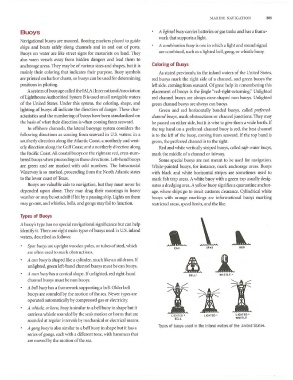
             Spar buoys are upright wooden poles, or tubes of steel, which                           HUN
                                                                          CAN           SPAR
             are often used to mark obstructions.
                                                                              ~~
             A ((111  blloy is shaped like a cylinder. much like an oil drum. If
             unlighted, green left-hand channel buoys must be can buoys.
             1111/11/ blloy has a conical shape. If unlighted. red right-hand   BEL L'       WHISTLE  •
             channel buoys must be nun buoys.
             II bell blloy has a framework supporting" bell. Older bell
             buoys are sounded by the Illotion of the sea. Newer types are
             operated automatically by compressed gas or electricity.
             A  whistle, or hom, blloy is similar to a bell buoy in shape but it
             carries a whistle sounded by the sea's motion or horns that are   LIGHTEO '   LIGHT EO '   lIGHTE O'
             sounded at regular intervals by mechanical or electrical means.   BELL                 WHIStl E
                                                                    Types at buoys used in the  inland waters of the  United States.
             A gOllg vlloy is also similar to a bell buoy in shape but it has a
             series of gongs, each with a different tone, with hammers that
             are moved by the motion of the sea.

