


Page 198 - NAVAL SCIENCE 3 TEXTBOOK
P. 198
204     NAVAL SKILLS


           The most important navigation lights are usually either flash-
        ing or occulting, since these patterns are the most easily identified.

        Visibility of a Navigation Light

           The visibility of a light is the distance, in nautical miles. a mari-
        ner can see the light at night. The distance at which a given naviga-
        tion light may be seen depends on its intensity and height above sea
        level, the height of eye of the observer. and the existing lIIeteorolog-
        im/llisibiiit)' collditiollS (weather). Information about the intensity
        and height of navigation lights can be found in publications called
        light  lists.  A navigator will  usually know his or her  height of eye
        at different positions on the vessel  from which he or she normally
        makes observations, and can estimate  the  meteorological  visibil-
        ity conditions in  any of several  ways,  \Vith  this  information, the
        navigator can compute the exact visibility of a light using various
        tables, A good approximation of the distance at which a light may
        be seell  is printed on nautical charts beside the light symbol. This
        chnrted mllge is  the distance a light will shine in clear weather and
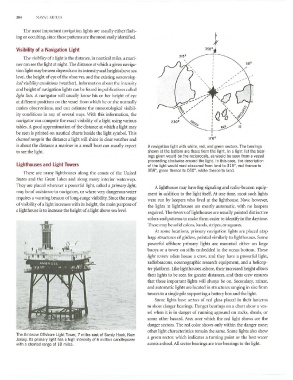
        is about the distance a mariner in a small boat can usually expect   A navigation light with white,  red,  and  green sectors,  The bearings
        to see the light.                                      shown  at the  bottom  are those from the  light.  In  a light list the  bear-
                                                               ings given Vlould  be  the reciprocals,  as would  be  seen  from a vessel
                                                               proceeding clockwise around the light.  In  this case,  the description
        Lighthouses and  Light Towers                          of the  light would  read  obscured from  land to 315°, red  thence to
                                                               358°, green thence to  050°, white thence to land.
           There  are  many lighthouses  along  the  coasts  of the  United
        States  and  the  Great  L1kes  and  along  many  interior waterways.
        The)' are  placed wherever a powerful  light, called  a prill/my light,
                                                                  A lighthouse may have fog-signaling and radio-beacon equip-
        may be of assistance to  navigators. or where veq' dangerous water
                                                               ment in  addition  to  the light itself. At one time, most such lights
        requires a warning beacon of long-range visibility. Since the range
                                                               were  run  by  keepers who lived  at the lighthouse.  Now,  however,
        of visibility of a light increases with its height, the main purpose of
                                                               the  lights  in  lighthouses  are  mostly  automatic.  with  no  keepers
        a lighthouse is to increase the height of a light above sea level.
                                                               required, The towers of lighthouses are usually painted distinctive
                                                               colors and patterns to make them easier to identif)' in the daytime,
                                                               These may be solid colors, bands, stripes, or squares.
                                                                  At  some locations,  primary navigation  lights are  placed  atop
                                                               large structures of girders, painted similarly to lighthouses, Some
                                                               powerful  ofl-shore  primary  lights  are  mounted  either  on  large
                                                               buoys or a tower on stilts embedded in  the ocean bottom. These
                                                               light  towers  often  house a  crew. and  they  have  a  powerful  light,
                                                               radiobeacons, oceanographic research  equipment, and a  helicop-
                                                               ter platform. Like lighthouses ashore, their increased height allows
                                                               their lights to be seen for greater distances, and their crew ensures
                                                               that these  important lights  will  always  be on,  Secondary,  minor,
                                                               and automatic lights are located in structures ranging in size from
                                                               towers to a single piJe supporting a battery box and the light.
                                                                  Some lights  have sectors  of red  glass  placed  in  their  lanterns
                                                               to show danger bearings. Danger bearings on a chart show a ves-
                                                               sel  when  it  is  in  danger of running aground on  rocks. shoals. or
                                                               some other hazard,  Arcs  over which  the  red  light  shows are  the
                                                               danger sectors, The red color shows only within  the danger zolle;
                                                               other light characteristics remain the same, Some lights also show
        The Ambrose Offshore Light Tower,  7 miles east of Sandy Hook,  New
        Jersey,  Its primary light has a high intensity of 6  million candlepower   a green  sector, which  indicates a  turning point or the best  water
        with a charted range  of  18 miles.                    across a shoal. All sector bearings are true bearings to the light.

