


Page 47 - NAVAL SCIENCE 3 TEXTBOOK
P. 47
52       NAVAL  KN OWL EDGE


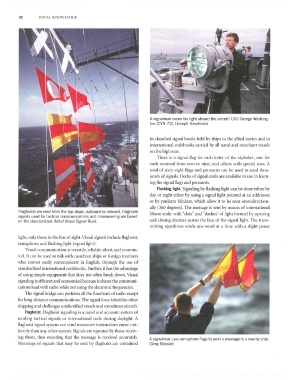
                                                                A signalman  mans his light aboard the aircraft USS  George Washing-
                                                                ton  (CVN  73).  (Joseph  Hendricks)


                                                                in  classified signal books held by ships in  the allied  navies and in
                                                                international codebooks carried by aLi  naval  and merchant vessels
                                                                on the high seas.
                                                                   There  is a signal flag  for  each letter of the alphabet,  one for
                                                                each  numeral from  zero  to nine, and others with special  uses.  A
                                                                total of sixty-eight flags  and pennants can be used  to  send thou-
                                                                sands of signals. Decks of signal cards are available to use in learn-
                                                                ing the signal flags and pennants.
                                                                   Flashing light. Signaling by flashing light can be done either by
                                                                day or night either by using a signal light pointed at an addressee
                                                                or by yardarm blinkers, which aLlow  it to be seen omnidirection-
                                                                ally (360 degrees). The message is sent by means of international
         Flaghoists are  read  from the top down, outboard to  inboard.  Flaghoist   Morse code, with "dots" and "dashes" of light formed by opening
         signals used  for tactical communications and  maneuvering are  based
         on  the standardized Allied Naval Signal Book.         and closing shutters across the face  of the signal light. The trans-
                                                                mitting signalman sends one word at a  time with  a slight pause

         light, only those in the line of sight. Visual signals include f1aghoist,
         semaphore, and flashing light (signal light).
            Visual communication is versatile, reliable, silent, and econom-
         ical. It can be used to talk with merchant ships or foreign mariners
         who  cannot  easily  communicate  in  English,  through  the  use  of
         standardized international codebooks. Further, it has the advantage
         of using simple equipment that does not often breal< down. Visual
         signaling is efficient and economical because it shares the communi-
         cations load with radio while not using the electronic frequencies.
            The signal bridge can perform all  the functions of radio except
         for long-distance communications. The signal force identifies other
         shipping and chaLlenges unidentified vessels and sometinles aircraft.
            Flaghoist.  Flaghoist signaling is a rapid and accurate system of
         sending tactical  signals  or international  code  during daylight.  A
         f1aghoist signal system can send maneuver instructions more uni-
         formly than any other system. Signals are repeated by those receiv-
         ing  them,  thus  ensuring  that  the  message  is  received  accurately.
                                                                A signalman  uses semaphore flags to send  a message to a nearby ship.
         Meanings of signals  that may  be sent by  f1aghoist  are  contained   (Greg Messier)

