


Page 91 - NAVAL SCIENCE 3 TEXTBOOK
P. 91
96       NAVAL  KNOWLEDGE

            Passage through  manmade canals is controlled  by ilgreel11cnt   The  following  sections  address  in  more  detail  the  current
         of the cOllntries  most  concerned.  In  peacetime they are open to   problem areas conccrning the law of the sea. These include prob-
         the use of all nations' ships, subject to a toll for the transit service.   lems related to economic zones, self-defense rules, exploitation of
         If nations not  holding title or interest in  the canal are at war, bel-  the continental shelf and seabeds, and fisheries.
         ligerent warships from eitht'l" side may use it. The canal is closed to
         belligerents at war with the controlling state; tor example, the Suez   Economic Zone  Problems
         and  Panama Canals were  not opell  to  Axis  powers during \ \'orld
                                                                   ~Iosl coastnl states now claim exclusi,'e jurisdiction over li\'ing
         War II.
                                                                and  nonliving resources within  200  miles of their coasts.  In  1976
                                                                the United  Stntes  extended  its jurisdiction  o\,er  fishel')'  rcsources
          Law  of t he  H igh Seas                              to 200 miles from  its coasts. This jurisdiction is limited to fisheries
                                                                and  differs from  sovereignt}'. Some countries  ha\'c  tried  to claim
         As  defined  by the  United  Nations Convention on the High  Seas,
                                                                absolute so\'Creignt)' that far from their coasts-and even beyond.
         the term high seas means "all parts of the sei1  that are not included
                                                                In  general, these  countries  assert  thnt  each coastal state has the
         in  the  territorial sea or in  the  internal waters of a state."  Over 70
                                                                right and duty to extend its jurisdiction into the high seas to what-
         percent of the world's surface is high seas, tj'ee tor all  the world to
                                                                ever extcnt it deems necessary for its economic needs. The region
         usc in its commerce.
                                                                extending beyond the 12-mile territorinl sea to about 200 miles out
            Freedom of the high seas includes freedom to  conduct mari-
                                                                is often referred to as the ('(01l011l;C ZOlle,
         time commerce, to  navigate.  10  fish. to  la), submarine cables and
                                                                   !vfany underdeveloped cOllnt ries view the de\'elopment of coastal
         pipelines, to ny over, and to  undertake scientific  research. In  exer-
                                                                fisheries as nn answer to their economic problems, since fishing docs
         cising these li'eedoms, reasoni1ble regard mllst be gi\'en to the rights
                                                                not  require  the  technology or tremendous capital  nceded for  off ...
         of others to  use the high seas.  For instance, it has been ruled  that
                                                                shore  mining or  petroleulll  e:\:ploitation. Other developing coun~
         in  the interest of general safety countries conducting wenpon tests
                                                                tries  hope to  persuade  foreign  interests having capital. equipment,
         at sea should stn)' clear of tra\'e1ed sea lanes. If a ship does enter the
                                                                and know-how to explore ilnd exploit their seabed for a share of the
         area,  howe\'er, the test, not the ship,  is  stopped. The  t~lCt that  the
                                                                profits. StiU  others have no desire to harvest certain ocenn resources
         sea  is  comlllon  to  nll  does not  pre\'ent  international agreements
                                                                lor themselves but W<lllt to claim jurisdiction over them and permit
         concerning it.  In  fact, the world community of states has seen fit
                                                                others to exploit thelll in  rehlfll for large license tces. The)' consider
         to establish  a body of maritime law to ensure that freedom of the
                                                                annexation of open space to be a legitimate menilS of compensati.ng
         seas will nppJ)' equally to nil. Consequently, conventions and trea-
                                                                tor the une\'en distribution of the world's wealth.
         ties ha\'e been conduded Oil safety of life and traffic at sea, snivage,
                                                                   \·Vhen  discussed in  law of the sen negotiations,  this issue  has
         international signals, fisheries,  the laying of cables and  pipelines,
                                                                been  cnlled  the  question  of the "residuum  of authority." That is,
         oil pollution, and the suppression of piracy nnd the slave trnde.
                                                                with  whom does the jurisdiction in  the 12-to-200-l1lile cconomic
            Every state has the right to grant its natiollnlit)' to ships and has
                                                                zone  rest-the coastnl state or the international  communit)' as a
         the  right  to  sail  them  under  its flag on  the high  seas. Such  ships.
                                                                whole? If the former, then the coash1l stnte could arbitrarily impose
         whether militnry or civil, are subject to the exclusi\'e jurisdiction of
                                                                restrictions on  navigation  within  the  zone. If the latter, only b)'
         the nntionaiity of the flag flowl1.  In  return for  these rights, ilI110ng
                                                                consent of all  the world's nations, eilht.'r through treaty or by evo-
         others,  the  state  must tnke  nil  measures necessary to ensure  the
                                                                lution of a new rule by custom, could restrictions on nonresource
         safety of the ship, crew, nnd passengers.
                                                                llses of the economic zone be imposed by the constnl state.
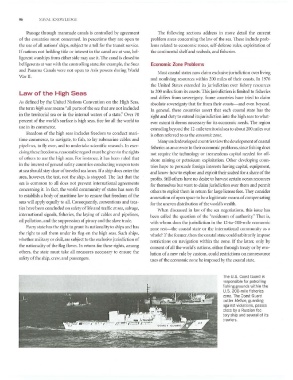
                                                                                               The  U.S.  Coast Guard  is
                                                                                               responsible for patrolling
                                                                                               fishing grounds within the
                                                                                               U.S.  200-mile fisheries
                                                                                               zone.  The Coast Guard
                                                                                               cutter Mellon,  guarding
                                                                                               against violations,  passes
                                                                                               close by a Russian  fac-
                                                                                               tory ship and several  of its
                                                                                               trawlers.

