


Page 226 - NS-2 Textbook
P. 226
OCEANOGRAPHY                                                                                          221


           A           ~JEAP TIDE
                        ()                 \\
                       FjrltOuart~r
                                             \   \

            Full  r,~oon  6-   -()----
           SPRING TIDE          SPRING TIDE
             ()
                                 New Moon


                       NEAP TIDE
                        ()
                        L~1t QU"tH
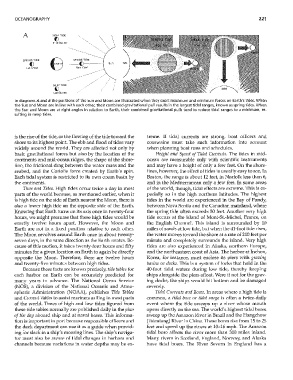
       In  diagrams A and B the positions of the Sun and  Moon are illustrated when they exert maximum and minimum forces on Earth's tides. When
       the Sun and Moon are in  line with each other, their combined gravitational pull results in the largest tidal ranges, known as spring tides. When
       the Sun  and  Moon are at right angles in  relation to Earth, their combined  gravitational pulls tend to reduce  tidal ranges to a minimum, re-
       sulting in  neap tides.


       is the rise of the tide, or the flowing of the tide toward the   treme.  If  tidal  currents  are  strong,  boat  officers  and
       shore to its highest point. The ebb and flood of tides vary   coxswains  lunst  take  such  information  into  accolmt
       widely around the world. They are affected not only by   when planning boat runs and schedules.
       basic gravitational forces but also by the location of the   Height a11d  Speed  of Tidal  Curreilts.  The tides in mid-
       continents and mid-ocean ridges, the shape of the shore-  ocean  are  nleasurable  only  with  scientific  instruments
       line, the frictional drag between the water mass and the   and may have a height of only a few feet.  On the shore-
       seabed, and  the  Coriolis  force  created by Earth's spin.   lines, howevel~ the effect of tides is usually easy to see. In
       Each tidal system is restricted to its own ocean basin by   Boston, the range is about 12 feet, in Norfolk less than 6,
       the continents.                                        and in the Mediterranean only a few feet. In some areas
           Time a11d  Tides.  High tides occur twice a day in most   of the world, though, tidal effects are extreme. This is es-
       parts of the """arld because, as mentioned earliel~ -when it   pecially so  in  the high northern latitudes.  TIle  highest
       is high tide on the side of Earth nearest the Moon, there is   tides in the world are experienced in the Bay of Fundy,
       also a lower high tide on the opposite side of the Earth.   between Nova Scotia and the Canadian mainland, ·where
       Knowing that Earth turns on its axis once in twenty-four   the spring tide often exceeds 50 feet. Another very high
       hours, we might presume that these high tides would be   tide occurs at the island of Mont-St.-Michel, France,  all
       exactly  tvvelve  hours  apart.  However,  the  Moon  and   the  English Channel.  TIlis  island  is  surroLmded  by 10
       Earth are  not in a fixed  position relative to  each other.   miles of sands at low tide, but when the 41-foot tide rises,
       The Moon revolves around Earth once in about twenty-   the water moves toward the shore at a rate of 210 feet per
       seven days, in the same direction as the Earth rotates. Be-  minute and completely surrounds the island. VelY high
       cause of this motion, it takes twenty-four hours and fifty   tides  are  also  experienced in Alaska,  northern Europe,
       minutes for a given location on Earth to again be directly   and the northeastern coast of Asia. The harbor at Inchon,
       opposite  the  Moon.  Therefore,  there  are  twelve  hours   Korea,  for  instance, must enclose its  piers "with gravi1lg
       and twenty-five minutes between high tides.            basiils or docks.  This is a system of locks that hold in the
           Because these facts are known precisely, tide tables for   40-foot  tidal  waters  during  low  tide,  thereby  keeping
       each  harbor  on  Earth  can  be  accurately  predicted  for   ships alongside the piers afloat. Were it not for the grav-
       many  years  in  advance.  The  National  Ocean  Service   ing docks, the ships would hit boltom and be damaged
       (NOS),  a  division  of  the  National Oceanic  and Atmo-  severely.
       spheric  Administration  (NOAA),  publishes  Tide  Tables   Tidal Currellts aild Bores. In areas where a high tide is
       and Curreilt Tables to assist mariners sailing in most parts   common, a tidal  bore  or tidal surge is often a  twice-daily
       of the world. Times of high and low tides figured from   event INhere  the  tide  sweeps up  a river  ,vhose  mouth
       these tide tables normally are published daily in the plail   opens directly on the sea. The world's highest tidal bores
       of the day aboard ship and at naval bases. This informa-  sweep up the Amazon River in Brazil and the Hangchow
       tion is important in port because responsible officers and   (Tsientang) River in Clllila. These bores rise from 15 to 25
       the deck department can use it as a guide when provid-  feet and speed up the rivers at 10-16 mph. The Amazon
       ing for slack in a ship's mooring lines. The ship's naviga-  tidal bore affects  the river more  than 300 miles inland.
       tor must also be aware of tidal changes in harbors and   Many  rivers in Scotland, England, Nor-way,  and Alaska
       channels because variations in ,vater depths may be ex-  have  tidal  bores.  The  River  Severn  in  England  has  a

