


Page 296 - NS-2 Textbook
P. 296
ASTRONOMY                                                                                             291


                                                     ()
                                   o


                                                 FIRST  QUARTER
                                                                                         (
                                    GIBBOUS                       CRESCENT
                                                                                         <
                                                                                         (
                     o       FULL  MOON             ()                 NEW  MOONe        <

                                                                                         < SUN'S
                                                    EARTH
                                                                                         ~ RAYS

                                    GIBBOUS                       CRESCENT               (
                                                                                         (
                                                 LAST  QUARTER                           <
                                  o                  ()


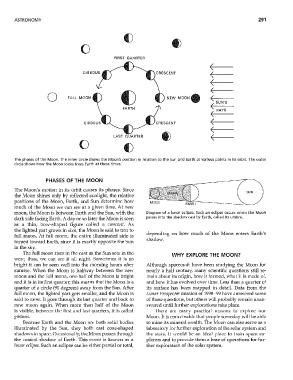
       The phases  of the Moon. The  inner circle  shows the Moon's position in relation to the Sun  and  Earth at various points in  its orbit. The outer
       circle shows how the Moon  looks from  Earth at these times.


                    PHASES  OF THE  MOON

       The Moon's motion in its orbit causes its phases. Since
       the Moon shines only by reflected sunlight, the relative
       positions  of the Moon, Earth,  and Sun determine how
                                                                               EARTH
       much of the Moon vve  can see at  a given time. At new
       moon, the Moon is between Earth and the Sun, with the   Diagram  of a lunar eclipse. Such  an  eclipse occurs when the Moon
       dark side facing Earth. A day or so later the Moon is seen   passes into the shadow cast by  Earth,  called  its  umbra.
       as  a  thin,  bow-shaped  figure  called  a  crescellt.  As
       the lighted part grows in size, the Moon is said to wax to
                                                              depending  on how  much  of  the  Moon  enters  Earth's
       full moon. At full  moon,  the entire  illuminated side is
                                                              shadow.
       turned toward Earth, since it is exactly opposite the Sun
       in the sky.
           The full moon rises in the east as the Sun sets in the        WHY EXPLORE THE  MOON?
       west;  thus,  we  can  see  it all night.  Sometimes  it  is  so
       bright it can be seen well into the morning hours after   Although spacecraft have been studying the Moon for
       sunrise.  When the  Moon is  halfway  between the  new   nearly a half century, many scientific questions  still re-
       moon and the full moon, one-half of the Moon is bright   main about its origin, how it formed, ,vhat it is made of,
       and it is in its first quarter; this means that the Moon is a   and how it has evolved over time. Less than a quarter of
       quarter of a circle (90 degrees) away from the Sun. After   its  surface  has  been mapped  in  detail.  Data  from  the
       full moon, the lighted part gets smaller, and the Moon is   LUllar Prospector mission of 1998-99 have answered some
       said to walle. It goes through its last quarter and back to   of these questions, but others will probably remain unan-
       new  moon  again.  When  more  than  half  of  the  Moon   swered tmtil further explorations take place.
       is visible, between the first and last quarters, it is called   There  are  many  practical  reasons  to  explore  our
       gibbous.                                               Moon. It is conceivable that people someday will be able
           Because Earth and the Moon are both solid bodies   to mine its nUneral "\vealth. The Moon can also serve as a
       illuminated  by  the  Sun,  they  both  cast  cone-shaped   laboratory for further exploration of the solar system and
       shadows in space. Occasionally, the Moon passes tlu'ough   the  stars. It would be an ideal place  to  train space ex-
       the  conical shadow of Earth.  This  event is known as  a   plorers and to provide them a base of operations for fur-
       /ullar eclipse.  Such an eclipse can be either partial or total,   ther exploration of the solar system.

