


Page 298 - NS-2 Textbook
P. 298
The Sun


       Earth has been warmed by the light of the Sun for 4.6 bil-  lion tons of helium by nuclear fusion, with 4 million tons
       lion years. Allille is maintained by the solar energy that   being converted into energy. About 40 percent of this en-
       is converted into chemical energy by plants. Moreover,   ergy escapes in the form of visible light, with most of the
       the power from all fossil fuels, water, and winds can be   rest radiated as ultraviolet light. Even with this fantastic
       traced back to the Sun. The Sun, therefore, is the source   rate of fuel constunption, the Stm is so massive that it is
       of most of the world's energy.  (The only exceptions are   estimated it will take another 5 billion years or more be-
       nuclear energy, lunar tidal energy, and the heat produced   fore its supply of hydrogen is exhausted.
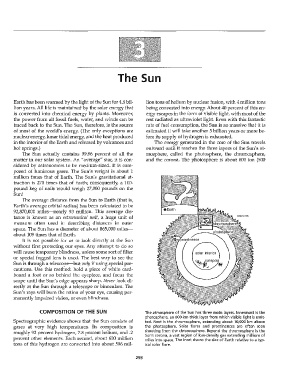
       in the interior of the Earth and released by volcanoes and   The energy generated in the core of the Sun travels
       hot springs.)                                          outward tmtil it reaches the three layers of the Sun's at-
          The  Sun  actually  contains  99.S6  percent  of all  the   mosphere,  called  the  photosphere,  the  chromosphere,
       matter in our solar system. An Llaverage" starf it is con-  and the corona. The photosphere is  about SOD  km (500
       sidered by astronomers to be medium-sized. It is com-
       posed of luminous gases.  The Sun's weight is  about 1
       million times that of Earth. The Sun's gravitational at-
       traction is 270  times that of Earth; consequently, a  100-
       pound keg of nails would weigh 27,000 pounds on the
       Sun!
          The average distance from the Sun to Earth (that is,
       Earth's average orbital radius) has been calculated to be
       92,870,000  miles-nearly  93  million.  This  average  dis-
       tance  is  known as  an astrollomical  lIllit,  a  huge tmit  of
       measure  often  used  in  describing  distances  in  outer
       space. The Sun has a diameter of about 865,000 miles-
       about 109 times that of Earth.
          It is not possible  for  us  to  look directly at the  Sun
       without first protecting our eyes. Any attempt to do so
       will cause temporary blindness, unless some sort of filter
       or special fogged  lens is  used.  The best way to see the
       Sun is tlu'ough a telescope--but oilly if using special pre-
       cautions.  Use  this method: hold  a piece of white card-
       board  a  foot  or so behind  the  eyepiece,  and focus  the
       scope until the Sun's edge appears sharp. Never look di-
       rectly at the Sun through a telescope or binoculars. The
       Sun's rays will burn the retina of your eye, causing per-
       manently impaired vision, or even blindness.


                  COMPOSITION OF THE  SUN                     The atmosphere of the Sun  has three main  layers.  Innermost is  the
                                                              photosphere,  an 800-km-thick layer from which visible light is  emit-
       Spectrographic evidence shows that the Sun consists of   ted.  Next  is  the chromosphere,  extending  about  10,000  km  above
       gases  at  very  high  temperatures.  Its  composition  is   the  photosphere.  Solar  flares  and  prominences  are  often  seen
       roughly 92 percent hydrogen, 7.8 percent helium, and .2   shooting from the chromosphere.  Beyond  the chromosphere  is  the
                                                              Sun's corona, a vast  region of low-density gas extending millions of
       percent other elements. Each second, about 600 million   miles into space.  The inset shows the size  of Earth  relative to a typ-
       tons of this hydrogen are converted into about 596 mil-  ical  solar flare.


                                                          293

