


Page 299 - NS-2 Textbook
P. 299
294                                                                                     NAUTICAL SCIENCES


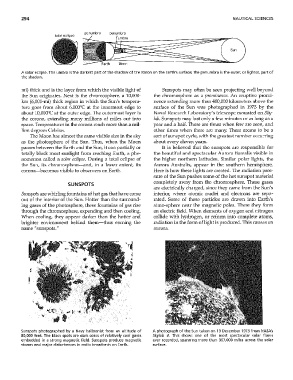
                                    penumbra   penumbra
                        total  eclipse


                                                                                                 Sun


          A solar eclipse. The umbra is the darkest part of the shadow of the Moon on the Earth's surface; the penumbra is the outer, or lighter, part of
          the shadow.

          mil thick and is the layer from which the visible light of   Sunspots may often be seen projecting well beyond
          the Sun originates. Next is  the chromosphere, a 10,000-  the  chromosphere  as  a prominence.  An  eruptive promi-
          km (6,000-mi)  thick region in which the Sun's tempera-  nence extending more than 400,000 kilometers above the
          ture  goes from  about 6,000°C  at the innermost edge to   surface  of  the  Sun  was  photographed  in  1973  by  the
          about 10,000°C at the outer edge. TI,e outermost layer is   Naval Research LaboratOlY's telescope mounted on Sky-
          the  corona,  extending many rnillions  of miles  out into   lab. Sunspots may last only a few minutes or as long as a
          space. Temperatures in the corona reach more than a mil-  year and a half. There are times when few are seen, and
          lion degrees Celsius.                                  other  times  when there  are  many.  There  seems to be a
              TI,e Moon has almost the same visible size in the sky   sort of sunspot cycle, with the greatest munber occmring
          as  the  photosphere of  the  Sun.  TIms,  when the Moon   about every eleven years.
          passes between the Earth and the Sun, it can partially or   It is believed that the slmspots are  responsible  for
          totally block most sunlight from reaching Earth, a phe-  the beautiful and spectacular Aurora Borealis visible in
          nomenon called a  solar eclipse.  During a  total eclipse of   the higher northern latitudes.  Similar polar lights,  the
          the  Sun, its  chromosphere-and,  to  a  lesser  extent,  its   Aurora Australis,  appear in the  southern hemisphere.
          corona~becomes visible to observers on Earth.          Here is how these lights are created. The radiation pres-
                                                                 sme of the Slm pushes some of the hot sunspot material
                                                                 completely away from  the  chromosphere.  TI,ese  gases
                             SUNSPOTS
                                                                 are electrically charged, since they came from the Sun's
          Sllnspots are whirling fountains of hot gas that have come   interior,  -where  atomic  nuclei  and  electrons  are  sepa-
          out of the interior of the Slm. Hotter than the surround-  rated.  Some  of  these  particles  are  drawn into  Earth's
          ing gases of the photosphere, these fOlmtains of gas rise   atmo-sphere near the magnetic poles.  There  they form
          through the chromosphere, expanding and then cooling.   an electric field. When elements of oxygen and nitrogen
          When cooling,  they appear darker than the hotter and   collide with hydrogen, or reform into complete atoms,
          brighter  environment  behind  them-thus  earning  the   radiation In the form of light is produced. This causes an
          nanle JlSlUlspotS."                                    aurora.


          Sunspots  photographed  by  a  Navy  balloonist from  an  altitude  of   A  photograph of the Sun  taken on  19 December 1973 from NASA's
          80,000 feet.  The  black spots  are  dark cores  of relatively cool  gases   Skylab  4.  This  shows  one  of  the  most  spectacular  solar  flares
          embedded  in  a strong  magnetic field.  Sunspots  produce  magnetic   ever recorded,  spanning  more  than  367,000  miles  across  the solar
          storms and  major disturbances in  radio broadcasts on Earth.   surface.

