


Page 303 - NS-2 Textbook
P. 303
298                                                                                     NAUTICAL SCIENCES

                                                               -...            ..... ....
                      ------------------------     ----          ---.....  ..............   ..... ............  ..... ....
                        ------------------              -------- -....    ............  ..............   .... ......  .... .....
                                              -------  ---....      -.........   ..........   ..... ......
                      --------------------------            -................   ........  ..............   ..........  .....,,,"-,   ' ....  ""
                                                     -....... -.....   ..............   ....' ..... "   ....  ..   "
                                                           -.....
                                                                    .... ..... ~"
                       ---- -------------  ------........,",',                                       \
                                                                                          '\
                       .. ,. ... ------------------  ..............   '........   \   \      \        \
                       /--(~)~>"'"'' "\  \  ~.'"'~                                           Y
                                                                       ~ 1
                                                                                             h..,"", I,
                                              OVenus/  8
                          I  /'"          "''oMerc~ry  OEarlh\  I   \  I    I        I        I    PlutoQ
                                            J
                                                I
                                                     I
                          \                /,        /1            J        f        I        I        I
                           ........ _-  _ .... ;         I        1         I    0           /         J
                                                                                              I
                                                                                     I
                       .......... _--  ---  ... -..-...-'"   .... /   dMars   /                        I
                             ---------        ............./       Jupiter   /    ~_~.- - Uranus   I   /
                       ...... _____   _  ____ ----  ........ ..-  ..    //         __       I        I
                       ....               -------                               //        //        /'
                        ---------------                _.....  ....././;/                          /
                                                           .... /",/
                                                  -_.......         ....    ",,/  ,/   //  /'    //  /
                       ~__                   __--             ~ ... '"  .... ... /   ;/   "     .I'
                          ------------ ---                 ....... ~     ,         /"         //
                                           -------------         ......... -...... //   /////   ///
                                ---------              ------  ... -        ",'"        .... /
                                                    ---               ... --  ,..-'"   .....
                       -----------------------                   ~..--..-""     .............  ...... /
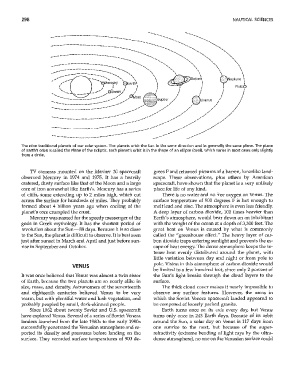
          The nine traditional planets of our solar system. The planets orbit the Sun  in the same direction and  in generally the same  plane. The plane
          of Earth's orbit is  called the Plane of the Ecliptic. Each  planet's orbit is  in the shape of an  ellipse (oval), which varies in  most cases only slightly
          from a circle.
              TV  cameras mounted  on the Mariner  10 spacecraft   grees F and returned pictures of a barren, hmarlike land-
          observed  Mercury  in  1974  and  1975.  It has  a  heavily   scape.  TIlese  observations,  plus  others  by  American
          cratered, dusty surface like that of the Moon and a large   spacecraft, have shown that the planet is a very unlikely
          core of iron somewhat like Earth's. Mercury has a series   place for life of any kind.
          of cliffs,  some extending up to 2 miles high, which cut   There is no water and no free oxygen on Venus. The
          across the surface for hundreds of miles. They probably   surface temperahrre of 900  degrees F is hot enough to
          formed  about 4  billion years  ago when cooling  of  the   melt lead and zinc. The atmosphere is even less friendly.
          planet's core crumpled the crust.                      A deep layer of carbon dioxide, 100 times heavier than
              Mercury was named for the speedy messenger of the   Earth's atmosphere, would bear down on an inhabitant
          gods in Greek mythology.  It has the  shortest period of   with the weight of the ocean at a depth of 3,300 feet. The
          revolution about the Sun-SS days. Because it is so close   great  heat  on  Venus  is  caused by what  is  commonly
          to the Sun, the planet is difficult to observe. It is best seen   called the "greenhouse effect." The heavy layer of car-
          just after sunset in March and April and just before sun-  bon dioxide traps entering sunlight and prevents the es-
          rise in September and October.                         cape of heat energy. The dense atmosphere keeps the in-
                                                                 tense heat evenly  distributed  around  the  planet, with
                                                                 little variation between day and night or from pole to
                                                                 pole. Vision in this atmosphere of carbon dioxide would
                               VENUS
                                                                 be limited to a few hundred feet, since only 2 percent of
          It was once believed that Venus was almost a twin sister   the Sun's light breaks  through the  cloud layers  to  the
          of Earth, because the two planets are so nearly alike in   surface.
          size, mass, and density. Astronomers of the seventeenth    The thick cloud cover makes it nearly impossible to
          and  eighteenth  centuries  believed  Venus  to  be  very   observe  any  surface  features.  However,  the  areas  in
          warm, but with plentiful water and lush vegetation, and   which the Soviet Venera spacecraft landed appeared to
          probably peopled by small, dark-skinned people.        be composed of loosely packed granite.
              Since 1962 about twenty Soviet and u.s.  spacecraft    Earth hrrns  once  on its  axis  every  day,  but Venus
          have explored Venus. Several of a series of Soviet Venera   hrrns  only once in 243  Earth days.  Because  of its orbit
          landers launched from the late 1960s to the early 19S0s   around the Sun, a solar day on Venus is 117 days from
          successfully penetrated the Venusian atmosphere and re-  one  sunrise  to  the  next,  but  because  of  the  super-
          ported its  density and pressures before landing on the   refractivity (extreme bending of light rays by the ultra-
          surface.  They recorded surface temperatures of 900  de-  dense ahnosphere), no one on the Venusian surface could

