


Page 307 - NS-2 Textbook
P. 307
302                                                                                     NAUTICAL SCIENCES


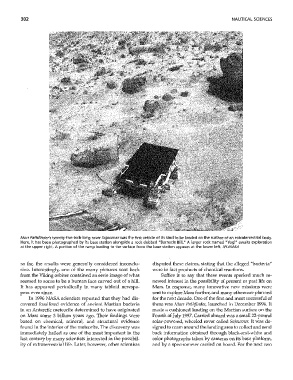
          Mars PathNnder's twenty-five-inch-long rover Sojourner was the first vehicle of its kind to be landed on the surface of an extraterrestrial body.
          Here,  it has  been  photographed by its base  station  alongside a rock dubbed "Barnacle  Bill."  A larger rock named  "Yogi"  awaits exploration
          at the upper right. A portion of the ramp leading to the surface from the base station appears at the lower left, JPL/NASA


          so far,  the results were generally considered inconclu-  disputed these claims, stating that the alleged "bacteria"
          sive. Interestingly,  one of the many pictures sent back   were in fact products of chemical reactions.
          from the Viking orbiter contained an eerie image of what   Suffice it to say that these  events sparked much re-
          seemed to some to be a human face carved out of a hill.   newed interest in the possibility of present or past life on
          It has appeared periodically  in many tabloid  newspa-  Mars.  In  response} many innovative new missions were
          pers ever since.                                       sent to explore Mars further, and many others are planned
             In 1996 NASA scientists reported that they had dis-  for the next decade. One of the fiTst and most successful of
          covered  fossilized  evidence  of ancient Martian bacteria   these was Mars  Pathft"del~ launched in December 1996. It
          in an Antarctic meteorite determined to have originated   made a cushioned landing on the Martian surface on the
          on Mars some 3 billion years  ago. Their findings were   Fourth of July 1997. Carried aboard was a small 22-pound
          based  on  cheillcat  mineral,  and  structural  evidence   solar-powered, wheeled rover called Sojourner.  It was de-
          fOlmd in the interior of the meteorite. The discovery was   signed to roam around the landing area to collect and send
          immediately hailed as one of the most important in the   back information obtained through black-and-white and
          last century by many scientists interested in the possibil-  color photographs taken by cameras on its base platform,
          ity of extraterrestrial life. Later, howevel~ other scientists   and by a spectrometer carried on board. For the next two

