


Page 206 - Jurnal Kurikulum BPK 2020
P. 206
Reliability of the Instruments

                       According  to  Beichner  (1994),  tests  with  KR-21  ≥  0.70  are  deemed  to  be  reliable
               measurements.  For  the  VST,  the  Kuder-Richardson  (KR-21)  reliability  coefficient  is  .80.
               Meanwhile,  Cronbach’s  alpha  is  used  to  check  the  internal  consistency  of  items  with
               polytomous scores. According to Tavakol and Dennick (2011), if the alpha value is higher than
               .90, it indicates that there are redundant items in the test. The coefficient alpha for the WAT is
               0.83, denoting that this test is also reliable.

               Assumption Check

                       Before performing multiple regressions, several assumptions were checked, namely,
               missing  values,  outliers,  normality,  independence,  multicolinearity  and  homoscedasticity
               (Tabachnick  &  Fidell,  2007).  All  the  steps  in  data  screening  show  the  values  within  the
               acceptable range.

                                            RESULTS AND DISCUSSIONS

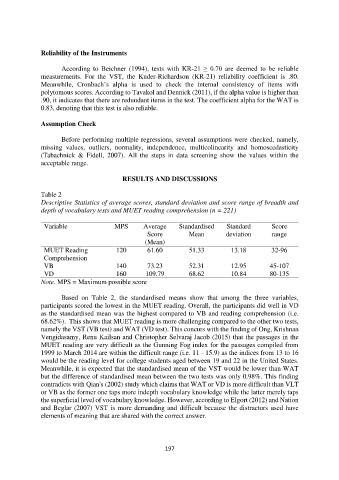
               Table 2
               Descriptive Statistics of average scores, standard deviation and score range of breadth and
               depth of vocabulary tests and MUET reading comprehension (n = 221)

                Variable                 MPS       Average      Standardised     Standard       Score
                                                     Score         Mean         deviation       range
                                                    (Mean)
                MUET Reading              120        61.60         51.33          13.18         32-96
                Comprehension
                VB                        140        73.23         52.31          12.95         45-107
                VD                        160       109.79         68.62          10.84         80-135
               Note. MPS = Maximum possible score

                       Based  on  Table  2,  the  standardised  means  show  that  among  the  three  variables,
               participants scored the lowest in the MUET reading. Overall, the participants did well in VD
               as the standardised mean was the highest compared to VB and reading comprehension (i.e.
               68.62%).  This shows that MUET reading is more challenging compared to the other two tests,
               namely the VST (VB test) and WAT (VD test). This concurs with the finding of Ong, Krishnan
               Vengidasamy, Renu Kailsan and Christopher Selvaraj Jacob (2015) that the passages in the
               MUET reading are very difficult as the Gunning Fog index for the passages compiled from
               1999 to March 2014 are within the difficult range (i.e. 11 - 15.9) as the indices from 13 to 16
               would be the reading level for college students aged between 19 and 22 in the United States.
               Meanwhile, it is expected that the standardised mean of the VST would be lower than WAT
               but the difference of standardised mean between the two tests was only 0.98%. This finding
               contradicts with Qian's (2002) study which claims that WAT or VD is more difficult than VLT
               or VB as the former one taps more indepth vocabulary knowledge while the latter merely taps
               the superficial level of vocabulary knowledge. However, according to Elgort (2012) and Nation
               and Beglar (2007) VST is more demanding and difficult because the distractors used have
               elements of meaning that are shared with the correct answer.


                                                           197

